
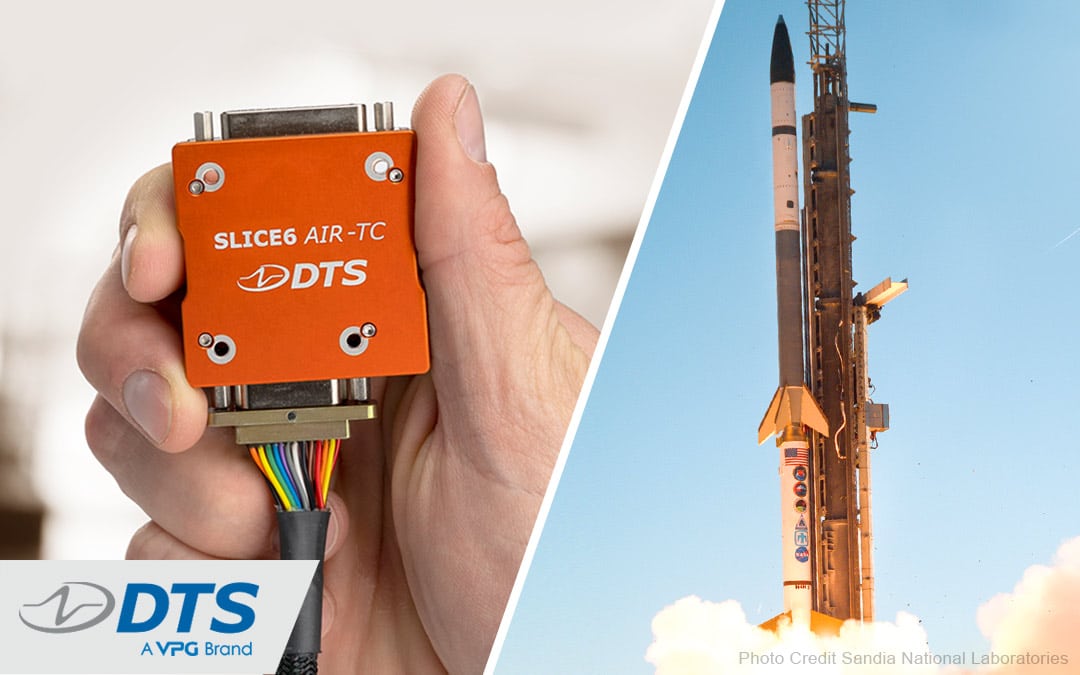
Thermocouple Measurements in Hypersonic Flight Testing with SLICE6 AIR-TC
By Mark Stansbury
There has been an acceleration of research into hypersonic testing recently with the emergence of the Department of Defense’s MACH-TB Program (Multi-Service Advanced Capability Hypersonics Test Bed). This initiative is designed to accelerate low-cost, high-cadence testing of hypersonic technologies across U.S. military and federal agencies.
The Challenges of Hypersonic Flight
Achieving hypersonic speed (faster than MACH-5 or 5X the sound barrier) is critical in defense as it allows vehicles to adjust altitude and flight path, making it less predictable and detectable when opponents try to defend or intercept. Hypersonic vehicles fly in a middle layer of the atmosphere, above airplanes but below satellites, where many existing radar systems are less effective at tracking fast-moving objects.
However, exceeding MACH-5 speeds (roughly 3,800+ mph) also has its drawbacks. The harsh thermal loads increase dramatically, and air chemically breaks down, ionizing and creating a plasma sheath around the vehicle. This plasma sheath affects the vehicle’s operations as it is exposed to extreme heat, shock, and turbulence simultaneously. Ultimately, this disrupts communication and sensing, distorting radio signals and leading to data loss in critical tests. If critical data is lost on a non-recoverable test article, nothing is left but an expensive experiment, which leaves zero room for error.
Data Acquisition Systems for Hypersonic Testing
When conditions are this harsh, there is only a small window of opportunity to gather data, which is why selecting the right test instrumentation is incredibly important. Traditional flight test instrumentation consists of a large bulky centralized data acquisition system with complicated cable running throughout the vehicle. Flight test setups are very time-and cost intensive, and this traditional solution can also lead to signal degradation due to the long sensor cables. DTS met this challenge by releasing the SLICE6 AIR, a miniature onboard data acquisition unit emerging as a market disruptor for hypersonic testing. With its rugged, SWaP-optimized packaging that could be placed near sensors, SLICE6 AIR has become the industry standard with its universal sensor support and flexible configurations.
As flight test instrumentation became more modular and lower-cost, single-function competitors began to enter the market. Engineers doing hypersonic testing have a limited need for universal sensor support for non-recoverable vehicles as they are primarily focused on measuring temperature. DTS took that industry feedback and developed an economic data acquisition system for one key sensor type: thermocouples.
The Solution: Thermocouple Data Acquisition
Introducing the SLICE6 AIR-TC, a thermocouple-specific data acquisition unit with less volume than its predecessor SLICE6 AIR. This SWaP-optimized system packs 24 thermocouple channels into a 42x42mm footprint, making it ideal for hypersonic flight testing. The idea was simple, make a version of the best-selling SLICE6 AIR system with key features and functionality, which meant eliminating onboard memory and universal sensor support to be cost-optimized for non-recoverable articles and test articles with tight size and mass restrictions.
The standard SLICE6 AIR-TC includes three 8-channel thermocouple interface blocks totaling 24 channels with smaller TC configurations available upon request. Each TC block handles all signal conditioning internally, incorporating cold junction compensation, a three-pole Butterworth filter, and 16-bit analog-to-digital conversion. As all conditioning is happening at the TC interface level, the module encodes and outputs that thermocouple data into an IRIG 106 compliant format (ex. Chapter 10).
Temperature Consideration in Hypersonic Environments
The TC interface is designed solely for thermocouple types K, S, T, and E. Each TC block is type-specific so multiple thermocouple types can be used simultaneously but not mixed within the same 8-channel block. This flexibility is critical in hypersonic environments where different zones of a vehicle may require different thermocouple types based on expected temperature range or material compatibility. For applications like propulsion testing, Type K thermocouples are the most common and cost-effective option, offering a temperature range of up to 1250°C. For vehicles sustaining MACH-5 speeds and 1600-2000°C temperatures, Type S is more suitable as the platinum-rhodium alloy offers greater stability in oxidizing environments. SLICE6 AIR-TC can be networked, supporting 240 thermocouple channels in one compact footprint.
SLICE6 AIR-TC for Legacy Flight Test Instrumentation
SLICE6 AIR-TC was specifically designed to be able to integrate into an existing flight test instrumentation architecture as an Ethernet-based thermocouple acquisition node without needing to completely redesign. It provides localized thermocouple signal conditioning, cold junction compensation, synchronized timing, and programmable sampling rates. It supports real-time data streaming, IRIG 106 Chapter 10, IENA, or TmNS, which allows engineers to add high-density temperature measurements while preserving the current data acquisition infrastructure and interoperability with existing FTI solutions. The unit is also shock-rated to 500g and qualified to MIL-STD-810G/461G.
The SLICE6 AIR Family
One key feature of the SLICE6 AIR-TC is that it can operate as a node of the SLICE6 AIR family platform. The SLICE6 AIR-TC shares the same communication and control bus as the SLICE6 AIR and SLICE6 AIR-BR, meaning all three modules can be daisy-chained together for a complete data acquisition system on the same test vehicle. Within this family, SLICE6 AIR-BR adds a compact strain-measurement module in the space-restrictive areas of the vehicle. A test vehicle may require mixed sensor architecture, so users do not have to choose between channel density, sensor flexibility, or time synchronicity. An engineer could easily position a SLICE6 AIR to measure shock and vibration, add a SLICE6 AIR-BR in tight spaces, and a SLICE6 AIR-TC in temperature-sensitive areas; all while maintaining synchronized timing via IRIG, GPS, or IEEE 1588 PTP.
The Future of Hypersonic Flight Testing with SLICE6 AIR-TC
The MACH-TB Program is rapidly shifting how the aerospace and defense industry approaches hypersonic flight testing. Because of the flux in industry participation, there has never been more emphasis on the need for reliable, low-cost data acquisition units for non-recoverable articles.
Since hypersonic flight testing is incredibly demanding on its equipment, a DAU can’t just survive the extreme thermodynamic conditions, it needs to deliver valid, reliable data while doing so. Whether it’s within the SLICE6 AIR platform or an existing flight test instrumentation architecture, the SLICE6 AIR-TC exceeds these expectations while supporting high-cadence testing schedules. With a short lead time of 4-6 weeks and one-third the cost-per-channel than the best-selling SLICE6 AIR, the SLICE6 AIR-TC is changing the industry by delivering low-cost, mission-critical data for hypersonic flight testing.
July 8, 2026
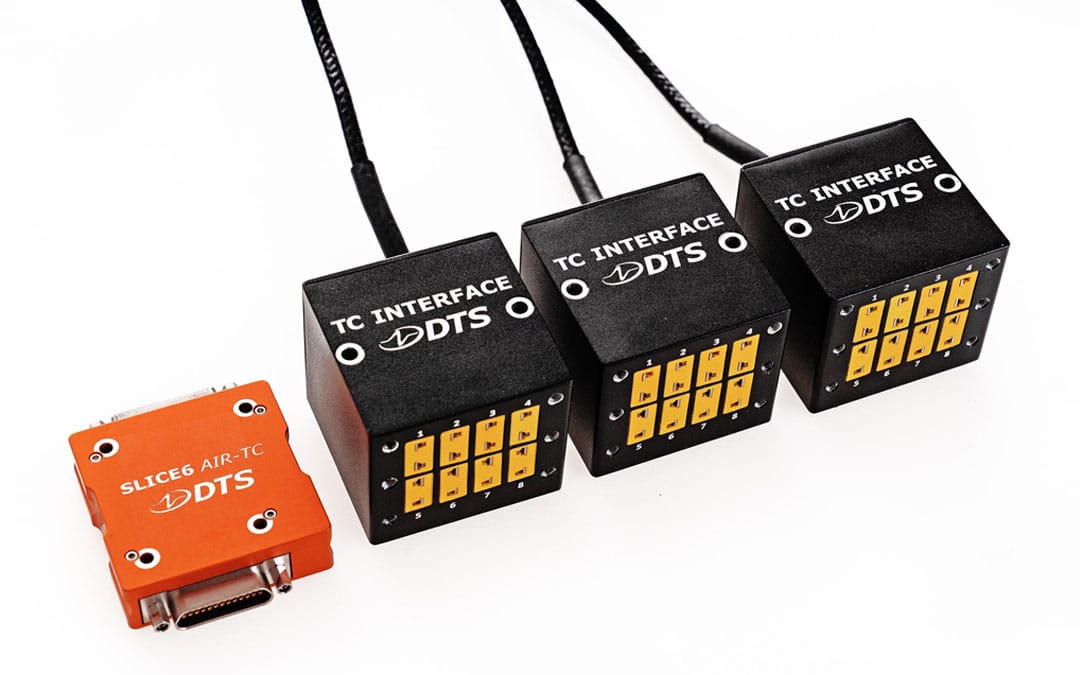
The SLICE6 AIR-TC allows you to position the DAU next to the sensors to reduce test set-up time and eliminate long cable runs.
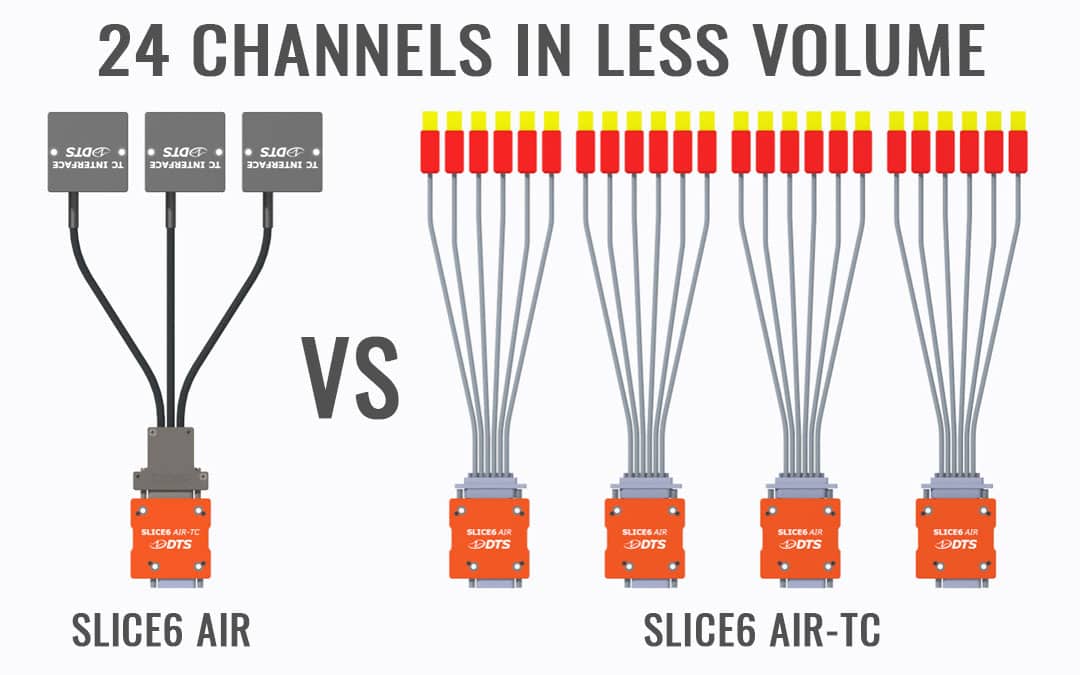
While the SLICE6 AIR is our best-selling DAU, customers wanted more thermocouple support for non-recoverable and disposable test articles. Built on the same flight-tested platform as the SLICE6 AIR, SLICE6 AIR-TC supports 24 thermocouple channels with less footprint and lower cost-per-channel.
Related Articles

DTS Named One of Orange County’s Best Places to Work for the Seventh Year in a Row!
For a 7th consecutive year, Diversified Technical Systems (DTS), headquartered in Seal Beach, California, was named as one of the Best Places to Work in Orange County.
![DTS Webinar [Now On Demand]: Disrupting Legacy Flight Test Instrumentation](https://dtsweb.com/wp-content/uploads/2026/03/ATI-Website-Promo-Graphic_March-2026-400x250.jpg)
DTS Webinar [Now On Demand]: Disrupting Legacy Flight Test Instrumentation
Disrupting Legacy Flight Test Instrumentation WEBINAR: THURSDAY, MARCH 19, 2026 Legacy flight test instrumentation is evolving fast. Miniature onboard DAQ is helping engineers capture more data, reduce wiring complexity, and install instrumentation closer to sensors....
Physical Data: The Engine Behind Digital Twins
DTS stands at the forefront of this new digital-twins frontier. Known for miniature, rugged data acquisition systems and sensors, DTS solutions can seamlessly bridge the gap between physical systems and their digital counterparts.