DTS Webinar Part 2 May 6 – Essential DAQ Knowledge

DTS Webinar Part 2 May 6 – Essential DAQ Knowledge

DTS Webinar Part 2 May 6 – Essential DAQ Knowledge

“DTS decided to put our years of experience to work and share our knowledge. There’s no school that teaches this, even though mastering these skills are key to anyone who does test data collection.”
– Steve Pruitt, CEO and Co-Founder of DTS

Principles of Dynamic Data Collection Part 2

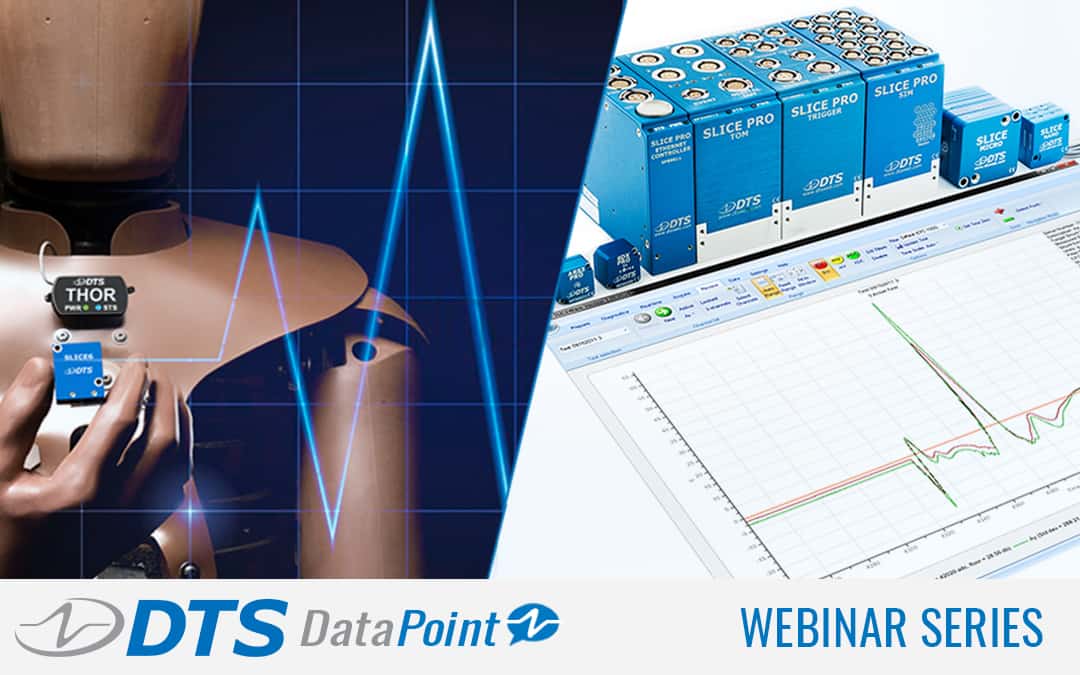
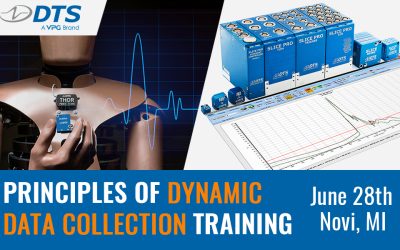
Learn best practices for making accurate test measurements by better understanding the fundamentals of data acquisition systems and sensors. Join us for a live 2-part webinar series titled Principles of Dynamic Data Collection. DTS has hosted versions of the training around the world to thousands of people – and now we are bringing it to the web.

NOTE: If you registered for PART 1 you will AUTOMATICALLY be REGISTERED for PART 2

Thurs April 30  /  Recording Available

Part 1 – DAQ Architecture and Sensor Theory

  • Data Acquisition Overview
  • Sensor Theory, Common Sensors & Limitations
  • Making measurements

Wed May 6  /  8:15am – 9:00am PDT

Part 2 – Essential DAQ Knowledge

  • Understanding the signal chain
  • Filtering and digital sampling
  • Dealing with real world challenges
  • Checklist for success

DTS has hosted versions of the training around the world to thousands of people – and now we are bringing it to the web. This webinar is designed for all levels of test professionals.

Registration is required.

Related Articles
SUBSCRIBE FOR DTS NEWS & UPDATES

YES! Sign me up

DTS Privacy Policy

14 + 4 =

Corporate

DTS Webinar Part 2 May 6 – Essential DAQ Knowledge

DTS Webinar Series – Principles of Dynamic Data Collection

DTS Webinar Series – Principles of Dynamic Data Collection

DTS LIVE WEBINAR (2-Part Series) – Principles of Dynamic Data Collection

Learn best practices for making accurate test measurements by better understanding the fundamentals of data acquisition systems and sensors. Join us for a live 2-part webinar series titled Principles of Dynamic Data Collection. DTS has hosted versions of the training around the world to thousands of people – and now we are bringing it to the web.

Thurs April 30  /  8:15am – 9:00am PDT

Part 1 – DAQ Architecture and Sensor Theory

  • Data Acquisition Overview
  • Sensor Theory, Common Sensors & Limitations
  • Making measurements

Wed May 6  /  8:15am – 9:00am PDT

Part 2 – Essential DAQ Knowledge

  • Understanding the signal chain
  • Filtering and digital sampling
  • Dealing with real world challenges
  • Checklist for success

DTS has hosted versions of the training around the world to thousands of people – and now we are bringing it to the web. This webinar is designed for all levels of test professionals.

“DTS decided to put our years of experience to work and share our knowledge. There’s no school that teaches this, even though mastering these skills are key to anyone who does test data collection. “ – Steve Pruitt, CEO and Co-Founder of DTS

Registration is required. Limited Seating Still Available.

Related Articles

SUBSCRIBE FOR DTS NEWS & UPDATES

YES! Sign me up

DTS Privacy Policy

12 + 9 =

Corporate

DTS Improving Air Force Pilot Safety with New Dynamic Impact Recorder

DTS Improving Air Force Pilot Safety with New Dynamic Impact Recorder

DTS Improving Air Force Pilot Safety with New Dynamic Impact Recorder

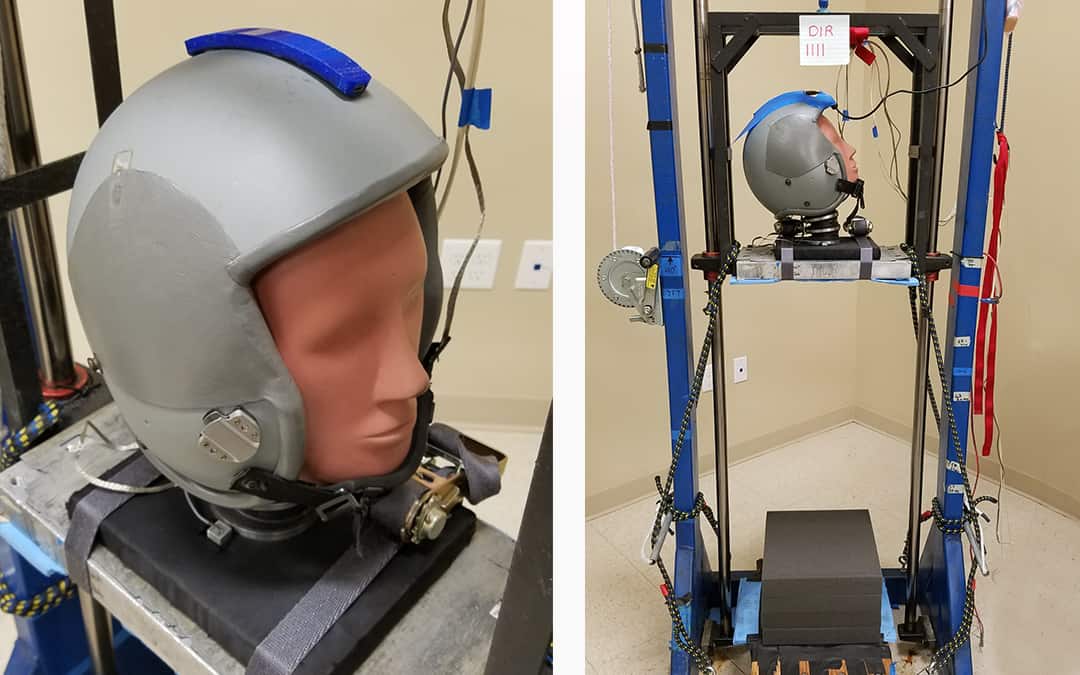
When Air Force pilots are forced to eject, they experience tremendous forces and physical stresses. During an ejection event pilots are hit with a gravitational force 14-16 times greater than normal. This puts them at serious risk of injuries including spinal damage, broken bones, as well as head and neck injuries. To help improve pilot safety, DTS is in the process of developing an innovative Dynamic Impact Recorder (DIR) that will gather data that can then be used to develop more effective protective gear including seating and restraints.

The concept and development of this new miniature dynamic impact recorder has come about as the result of a Small Business Innovation Research Award given to DTS to help advance pilot safety for the United States Air Force.

The New Dynamic Impact Recorder – Small Enough to Fit in Helmet

This new recorder will have the capacity to collect acceleration, force and angular velocity measurements, that a fighter pilot may experience during an emergency ejection event. One big obstacle is to create a design that allows the sensors and data recorder to be placed as close to the points of interest (such as the head) as possible – without limiting typical movements a pilot must perform in the course of a flight or unanticipated event. This DIR will be small enough to embed in a helmet and have an enclosure that is rugged enough to withstand the forces of flight and ejections.

The big challenge for DTS design engineers is size, mass and center-of-gravity (CoG). The technology needs the capacity to accurately gather field data with human subjects in extreme environments, without altering test dynamics. DTS’ ultra-low power designs are significantly smaller and lighter than similar systems on the market and the new unit will feature six degree of freedom (6DOF) sensing and onboard memory so all data will be stored in place to non-volatile memory.

DTS has been awarded numerous Small Business Innovation Research contracts, both Phase 1 and Phase 2 awards. Phase 1 is the conceptual phase and we are now in Phase 2, working toward a final design that will contribute to improving Air Force pilot safety.

DTS has 30 years of experience developing innovative data recorders and sensors used around the world for safety testing in aerospace, military, and automobile industries. For more information about the awards and the dynamic impact recorder, go to DTS Awarded SBIR Contracts to Advance US Sir Force and NASA Flight Crew Safety.


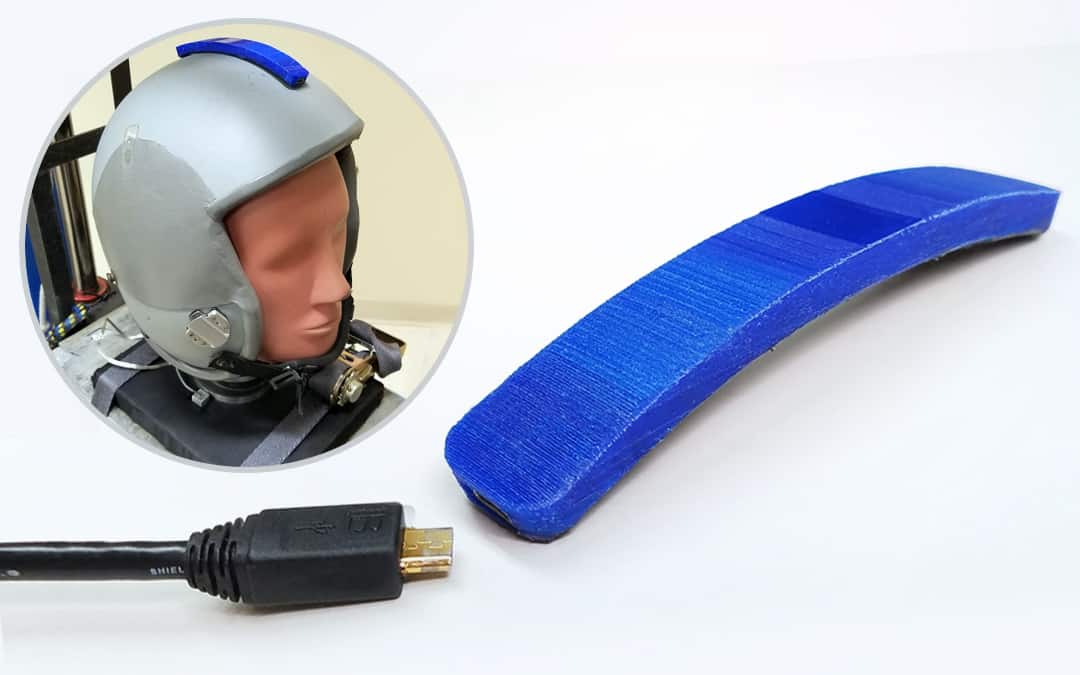
The miniature Dynamic Impact Recorder DTS is developing for the U.S. Air Force will measure forces that pilots may experience during an emergency ejection maneuver. The unit (shown as a prototype on the helmet) will collect data used to improve safety gear for USAF pilots.

Related Articles

SUBSCRIBE FOR DTS NEWS & UPDATES

YES! Sign me up

DTS Privacy Policy

13 + 3 =

Corporate

Angular Velocity Measurements Made Easy

Angular Velocity Measurements Made Easy

Angular Velocity Measurements Made Easy

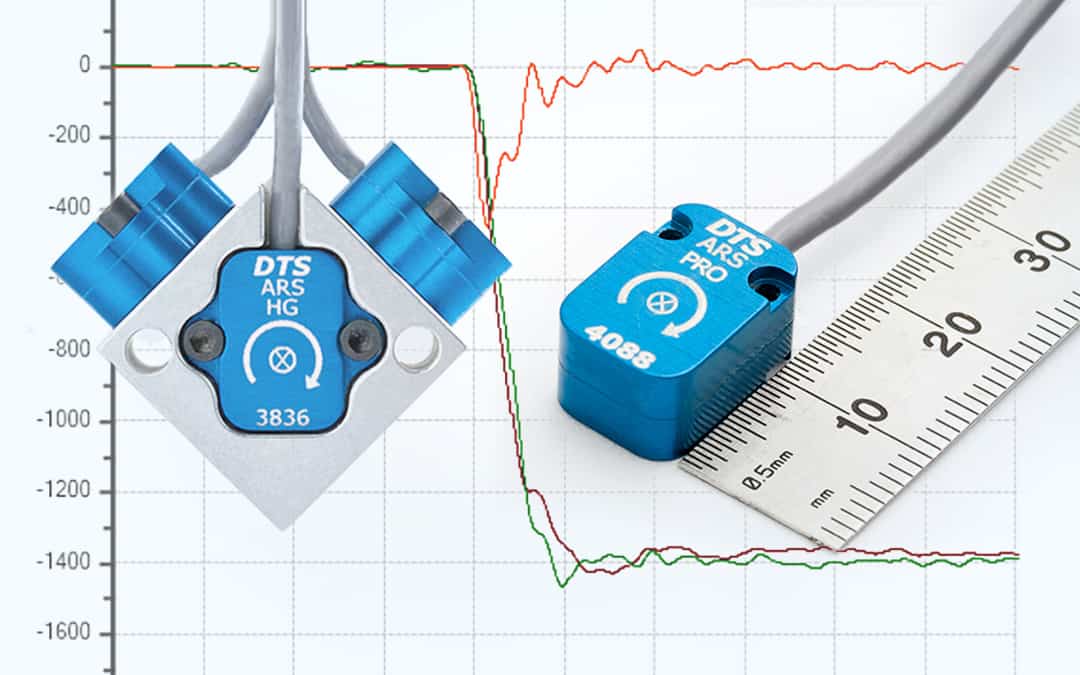
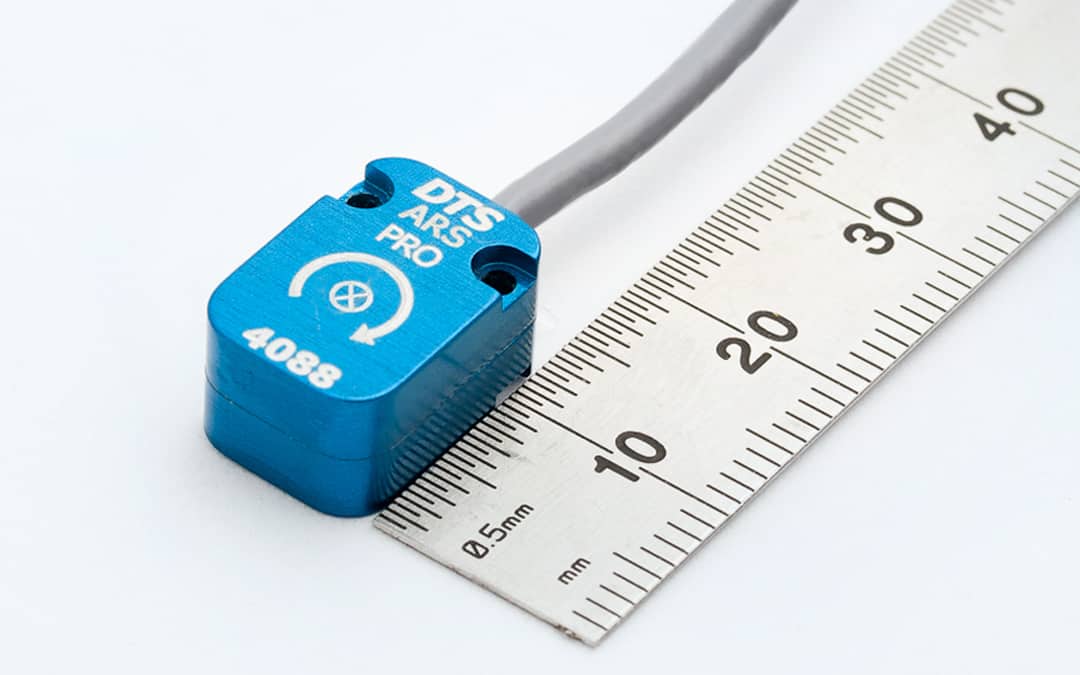
DTS ARS PRO is the original high-speed angular velocity rate sensor designed for a wide range of applications, the ARS PRO is ideal for vehicle handling, crash, injury biomechanics and high-rate ballistics testing.

The single axis ARS PRO is a silicon-based microelectromechanical system (MEMS) that uses a resonating gyro to measure angular velocity. Miniature and rugged, other key advantages include DC response and low power requirements. 

DTS ARS PRO is the world’s smallest, high performance angular velocity rate sensor. Also available in a triaxial model (ARS3 PRO), as well as a compact six degrees of freedom package (6DX PRO). For more information and detailed specifications check out our ARS PRO product page.

All models are linear over the rated range and comply with SAE and ISO recommended practices for frequency response in all applications. DTS offers full-scale ranges from ±300 to ±50000 deg/sec and bandwidths up to 2000 Hz, fully supporting CFC 180 and 1000 testing requirements. The ARS PRO-1500 is even NHTSA-specified for FMVSS 2020a rear impact testing.

DTS also offers the ARS HG with an impressive 10000 g shock rating, the highest in the industry, which features reinforced mounting points designed to withstand high energy test environments including blast and missile. All models are packaged in compact rugged enclosures and weigh only 2.5 grams. Other features like high output voltage and shunt check capability put the ARS PRO in a class by itself.

DTS ARS PRO and ARS HG are the world’s smallest high shock & vibration tolerant angular rate sensors designed for vehicle handling, crash, injury biomechanics and high-rate blast testing.

The DTS triaxial mounting block makes it easy to create a custom six degrees of freedom sensor package by adding three accelerometers.

DTS ARS PRO and ARS HG are the world’s smallest high shock and vibration tolerant angular rate sensors designed for vehicle handling, crash, injury biomechanics and high-rate blast testing.

Related Articles

SUBSCRIBE FOR DTS NEWS & UPDATES

YES! Sign me up

DTS Privacy Policy

9 + 5 =

Corporate

DTS Marks Milestone for U.S. Warfighter Safety

DTS Marks Milestone for U.S. Warfighter Safety

DTS Marks Milestone for U.S. Warfighter Safety

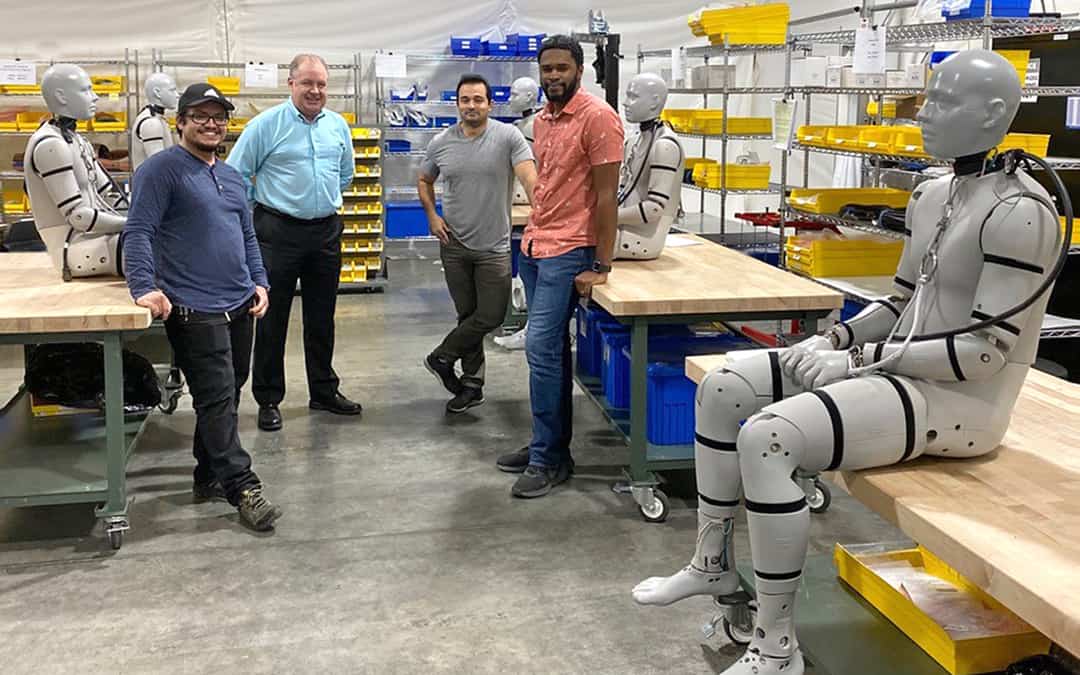
DTS has just accomplished a significant milestone to advance U.S. warfighter safety. The first five production WIAMan Blast Test Manikins with SLICE6 in-dummy DAS have been manufactured, delivered and accepted by the U.S. Government. Congratulations to the DTS ATD team, Engineering and Operations for making this happen. The next five ATDs on this delivery order are already in progress for the July shipment to the U.S. Government.

The U.S. Army Warrior Injury Assessment Manikin (WIAMan) is a biofidelic, warfighter test dummy engineered to assess potential skeletal injuries of soldiers exposed to underbody blasts (UBB). WIAMan is the first ATD with embedded SLICE6 dummy DAS to measure vertical loads. WIAMan supports up to 156 channels of integrated SLICE6 in-dummy DAS.

DTS is the Prime Contractor to the U.S. Army for the WIAMan project, which is the first anthropomorphic test device (ATD) designed specifically to withstand underbody blasts (like IEDs). The goal of all WIAMAN testing is to advance soldier protection and improve military vehicle designs. For more information visit our WIAMan Blast Manikin ATD Solutions page.

Related Articles

SUBSCRIBE FOR DTS NEWS & UPDATES

YES! Sign me up

DTS Privacy Policy

4 + 14 =

Corporate

Miniature Impact Recorder Advances U.S. Air Force Pilot Safety

Miniature Impact Recorder Advances U.S. Air Force Pilot Safety

Miniature Impact Recorder Advances U.S. Air Force Pilot Safety

Seal Beach, CA – Diversified Technical Systems (DTS) is developing a miniature Dynamic Impact Recorder (DIR) for the United States Air Force to help improve pilot safety. This new DIR will be used to collect field data on the forces fighter pilots may experience during emergency ejection seat events.

Pilots, when forced to eject, are hit with a gravitational force 14-16 times greater than normal, putting them at serious risk of head and neck injuries, broken bones and spine damage. The data collected from this new technology will be used to develop next generation protective gear including restraints and seating. This innovative data recorder is being developed by DTS as part of a Phase 2 Small Business Innovation Research (SBIR) Award to help the U.S. Air Force.

“Many of the current generation DTS products owe a debt to the SBIRs we have been awarded over the years. Technology we originally engineered for NASA, the U.S. Army or Air Force has evolved into a variety of COTS products that customers around the world are using for crash, blast and injury biomechanics testing,” said Mike Beckage, co-founder and CTO of DTS.

Collecting field data without altering test dynamics can be challenging, especially when human subjects are involved. Positioning the sensors and data recorder as close as possible to the point of interest, without hindering or restricting typical movement, is the real challenge.

The Dynamic Impact Recorder will collect acceleration, force and angular velocity measurements that a pilot may experience during an emergency ejection. The DIR features a triaxial accelerometer, a triaxial angular rate sensor, and additional pressure and temperate sensors in a tiny rugged enclosure. With no sensor cables to route and its lower power components, the DIR will be so small it can be placed on the pilot and will likely be embedded in the helmet.

The SBIR program works with U.S. small businesses on federal R&D projects that have the potential for commercialization. DTS has received numerous Phase 1 and Phase 2 SBIR awards based on its expertise in test and measurement solutions for automotive crash safety and soldier mild traumatic brain injuries caused by blunt impact and blast overpressure.

The miniature Dynamic Impact Recorder DTS is developing for the U.S. Air Force will measure forces that pilots may experience during an emergency ejection maneuver. The unit (shown as a prototype on the helmet) will collect data used to improve safety gear for USAF pilots.

Related Articles

SUBSCRIBE FOR DTS NEWS & UPDATES

YES! Sign me up

DTS Privacy Policy

1 + 8 =

Corporate

Crash Test Magazine – Angular Velocity Measurement

Crash Test Magazine – Angular Velocity Measurement

Crash Test Magazine – Angular Velocity Measurement

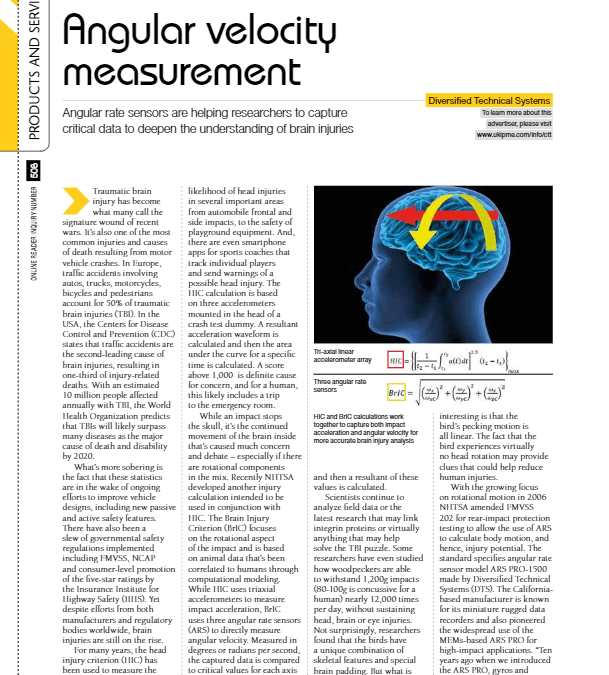
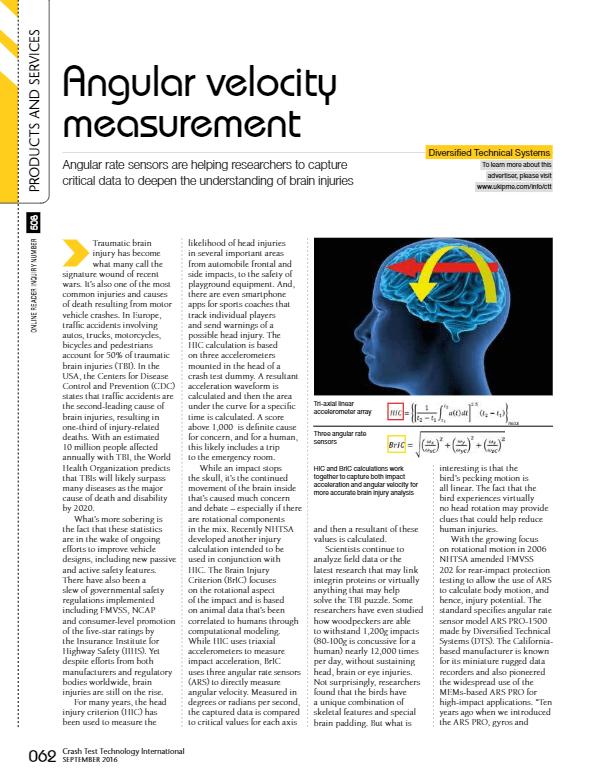
Angular Velocity Measurement 

Crash Test Technology International 

Angular rate sensors are helping researchers to capture critical data to deepen the understanding of brain injuries.

Related Articles

SUBSCRIBE FOR DTS NEWS & UPDATES

YES! Sign me up

DTS Privacy Policy

7 + 14 =

Corporate

Triaxial Angular Rate Sensor Excels in Challenging Test Environments – ARS3 PRO

Triaxial Angular Rate Sensor Excels in Challenging Test Environments – ARS3 PRO

Triaxial Angular Rate Sensor Excels in Challenging Test Environments – ARS3 PRO

Collecting pitch, roll and yaw data on test articles with tight size or weight restrictions just got easier. The ultra-small triaxial angular rate sensor, ARS3 PRO delivers precision angular velocity measurements, even in excessive shock and vibration environments.

Unlike an accelerometer that measures linear motion, the ARS3 PRO (triaxial angular rate sensor) measures high rates of angular velocity. From lever durability to life-cycle testing of a car door or RPM of a driveshaft, the miniature ARS3 PRO is designed to be positioned near the point of interest. It’s also ideal for collecting in-situ data on helmets and sports gear like hockey sticks, without altering the CoG or test dynamics. 

The ARS3 PRO Triaxial Angular Rate Sensor measures position and even RPM in virtually any moving part without affecting test dynamics. Ideal for test articles with tight size and weight restrictions, the ultra-small ARS3 PRO measures X, Y and Z angular velocity in high shock and vibration test environments. For more information and detailed specifications check out DTS ARS3 PRO.

 The aluminum 19 x 19 x 12.5 mm enclosure is IP67 rated, weighs only 9 grams and is shock rated to 10,000 g. The triaxial package is 50% smaller and 40% lighter than even three DTS ARS PRO uniaxial sensors on a mounting block. Available in ranges from ±300 to 50K deg/sec and in multiple bandwidths, the ARS3 PRO features DC response and shunt check capabilities.

It’s an evolution of DTS innovation combining the inherent reliability and proven performance of its single axis predecessor with super high-rate ranges incorporating triaxial angular rate sensors for applications like aerospace, ballistics and vehicle crash safety.

The ARS3 PRO meets the latest U.S. government dynamic performance requirements – read more including detailed specifications on our ARS3 PRO page.

The ultra-small ARS3 PRO measures X, Y and Z angular velocity in high shock and vibration test environments.

The ultra-small ARS3 PRO measures X, Y and Z angular velocity in high shock and vibration test environments.

Related Articles

SUBSCRIBE FOR DTS NEWS & UPDATES

YES! Sign me up

DTS Privacy Policy

4 + 7 =

Corporate

Covid-19 Update – How DTS is Responding

Covid-19 Update – How DTS is Responding

Covid-19 Update – How DTS is Responding

Seal Beach, CA – (Apr. 27, 2020, Update)
Dear Valued Clients and Associates,
We are open.
At this time all DTS offices worldwide remain open and ready to respond to your needs. We continue to monitor the Coronavirus pandemic and respond with our best efforts. The Health and Safety of our staff, clients, suppliers and agents is our top priority.

We will continue to navigate these uncertain times by being responsible citizens, while also striving to meet commitments to our customers. As part of the Defense Industrial Base, DTS along with many of our clients and suppliers have a responsibility to continue to operate as part of the Critical Infrastructure of the United States.

Our staff is our first priority. We have implemented CDC guidelines for hygiene practices in the workplace, including requiring every employee reporting in for work to record their temperature daily. Employees with elevated temperatures, symptoms of illness or known contact with infected individuals will not be allowed to enter our workplace. All travel has been eliminated or minimized to only what is safe and essential.

Our scheduling and planning team is working daily to accommodate all customers, with top priority shipments based on customer needs. DTS will communicate regarding any deliveries that may be impacted and work with you to find the best solution. We encourage our clients to contact customerservice@dtsweb.com or sales@dtsweb.com regarding any requests to:

• move scheduled orders out
• bring orders in to ship early
• accept partial shipments

Product calibration and repairs continue at all DTS support sites. The COVID-19 outbreak requires that we work differently, but we are working to maintain standard lead times and meet customer needs. For customers that normally take advantage of our on-site calibration services, we are offering complimentary shipping to a DTS support site closest to you.

DTS has implemented staggered work shifts and work-from-home practices. Our Engineering and Software teams are following our 2020 business plan to ensure product development timelines stay on track. Our Sales and Business Development teams are available to discuss current and future opportunities.

Thank you for your ongoing support and partnership. Our company mission is to be the most trusted provider in the markets we serve. We aim to honor that objective through these challenging times and the future.

Sincerely,

Steve Pruitt, CEO

Rollin White, President

Corporate

DTS Names New Director of Sales & Marketing

DTS Names New Director of Sales & Marketing

DTS Names New Director of Sales & Marketing

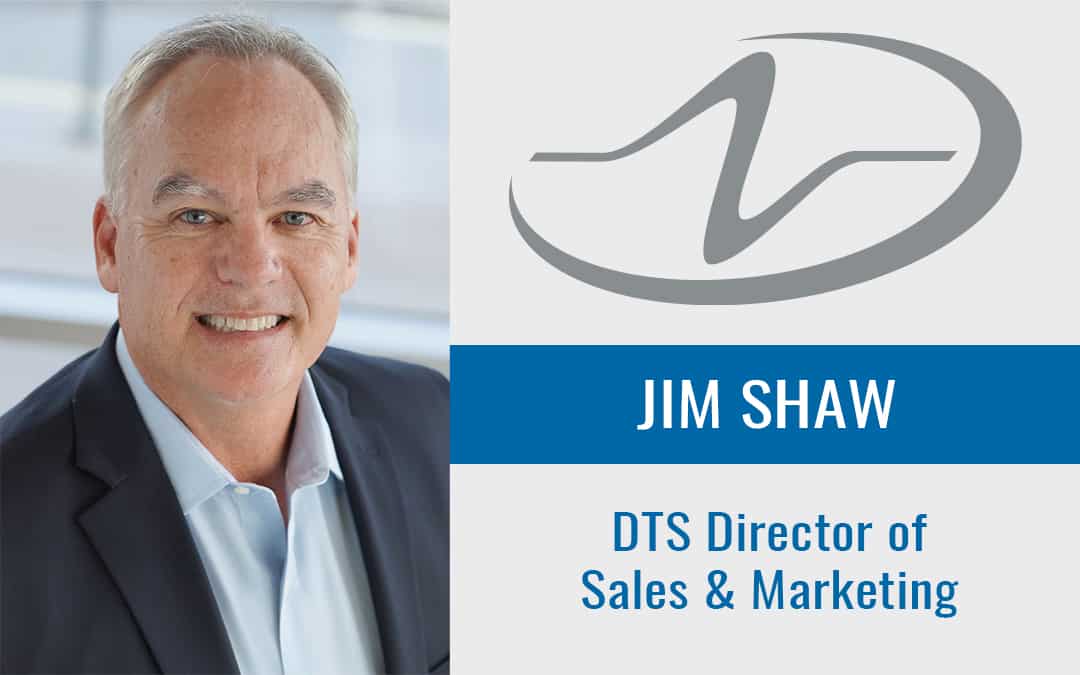
Diversified Technical Systems (DTS) announces that Jim Shaw has joined the company in the position of Director of Sales & Marketing. He brings over 30 years of experience in test and measurement to DTS, a leading manufacturer of data recorders and sensors for injury biomechanics and product testing. Jim’s experience in global channel partner development and engineering services will be key to help direct and expand DTS growth.

Jim has successfully lead teams focused on COTS hardware and software solutions, as well as turnkey integrated systems. His extensive experience in aerospace, defense and general test and measurement all serve as an excellent foundation for DTS markets. 

“I am honored for the opportunity to join the DTS family, and excited to take on this new challenge. The highly differentiated products, along with the quality of people and unique corporate culture were what attracted me to the role,” said Shaw. “I look forward to engaging with our customers and working closely with the team to explore new opportunities to help drive future growth.”

Related Articles

SUBSCRIBE FOR DTS NEWS & UPDATES

YES! Sign me up

DTS Privacy Policy

12 + 1 =

Corporate

HELP CENTER