DTS Named One of Orange County’s Best Places to Work for the Seventh Year in a Row!

DTS Named One of Orange County’s Best Places to Work for the Seventh Year in a Row!

DTS Named One of Orange County’s Best Places to Work for the Seventh Year in a Row!
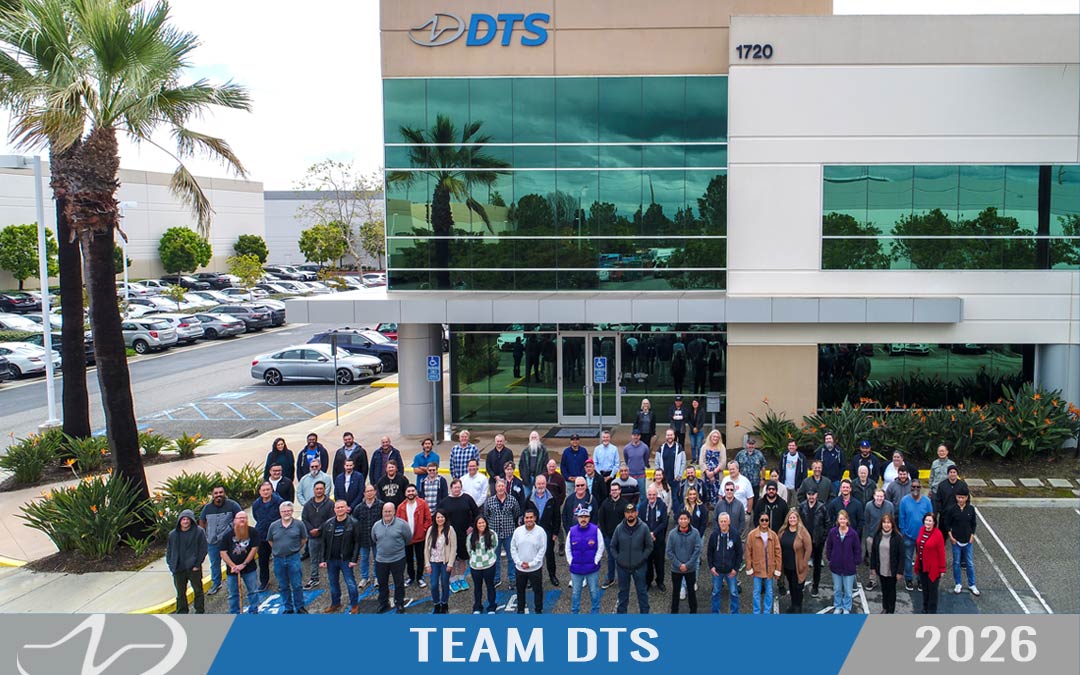
DTS Best Places to Work 2026

DTS Named One of Orange County’s Best Places to Work for the Seventh Year in a Row!

Diversified Technical Systems (DTS) is proud to announce that we’ve been recognized as one of the Best Places to Work in Orange County for 2026 by the Orange County Business Journal and Workforce Research Group. This recognition highlights companies across Orange County that prioritize their people, build strong workplace cultures, and create environments where employees can thrive.

Earning this award for the seventh year in a row is a meaningful milestone for DTS. It speaks to the dedication of our team, the relationships we’ve built, and the shared commitment that continues to shape our company culture year after year.

“Being named one of Orange County’s Best Places to Work for the seventh consecutive year is an honor. This recognition reflects the outstanding employees and strong culture that make DTS a great place to work.”-Rollin White, President of DTS

The Best Places to Work in Orange County program evaluates participating companies through a combination of employer information and confidential employee feedback. To be considered, organizations must meet key eligibility requirements, including having at least 15 full- or part-time permanent employees in Orange County, maintaining a physical operation in Orange County, operating as a public, private, for-profit, not-for-profit, or government organization, and being in business for at least one year by the program registration deadline.

• 20% of the score is based on workplace policies, practices, and company demographics
• 80% is based on employee survey responses focused on experience, engagement, and satisfaction

At DTS, the people make the difference. Our drive to solve complex challenges for our customers is what inspires the work we do every day. Thank you to every DTS employee whose collaboration and commitment continue to make our workplace culture worth celebrating!

DTS Company Group Photo 2026

Related Articles

Physical Data: The Engine Behind Digital Twins

Physical Data: The Engine Behind Digital Twins

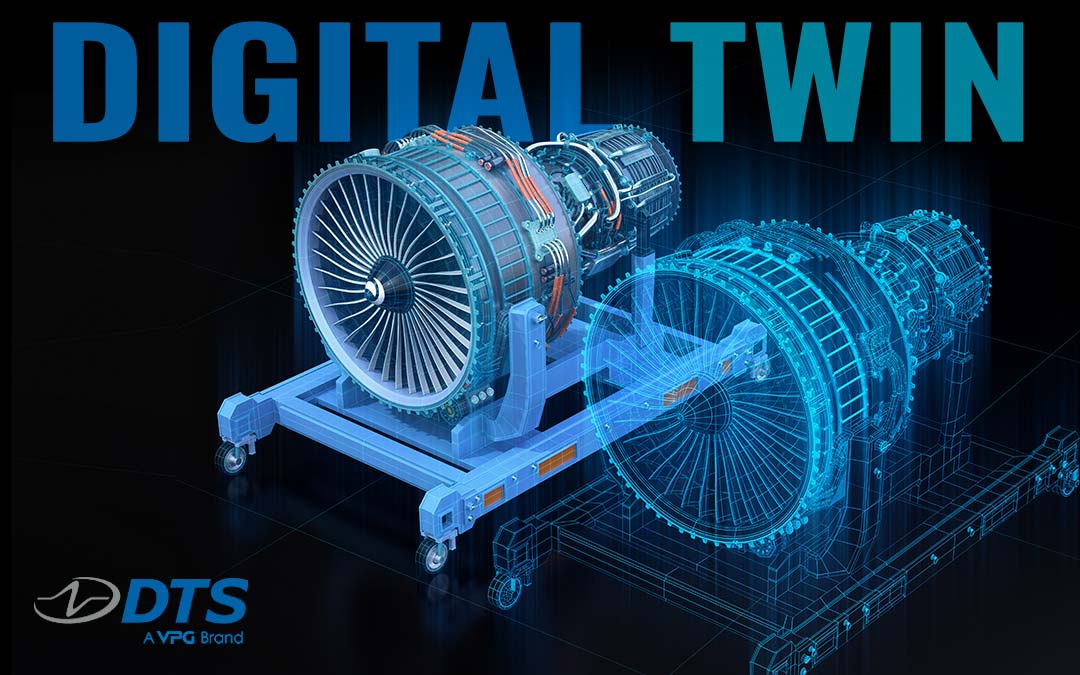
DTS stands at the forefront of this new digital-twins frontier. Known for miniature, rugged data acquisition systems and sensors, DTS solutions can seamlessly bridge the gap between physical systems and their digital counterparts.

Thermocouple Measurements in Hypersonic Flight Testing with SLICE6 AIR-TC

Thermocouple Measurements in Hypersonic Flight Testing with SLICE6 AIR-TC

Thermocouple Measurements in Hypersonic Flight Testing with SLICE6 AIR-TC
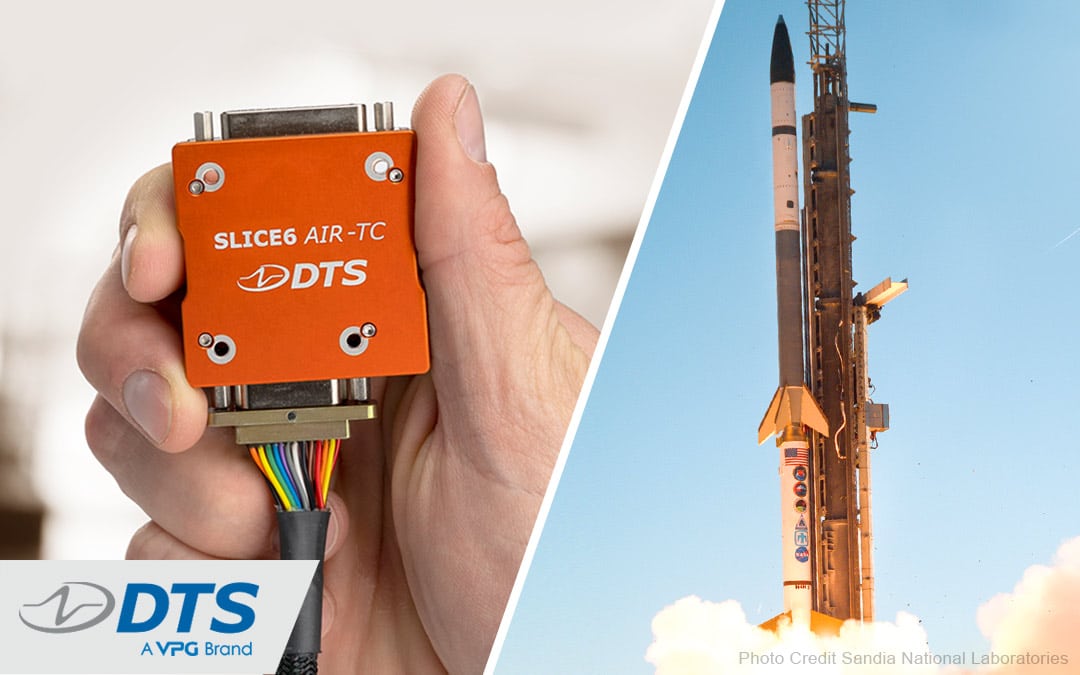
DTS SLICE6 AIR-TC and Hypersonic Rocket Application - Photo Credit Sandia National Laboratories

Thermocouple Measurements in Hypersonic Flight Testing with SLICE6 AIR-TC

By Mark Stansbury

There has been an acceleration of research into hypersonic testing recently with the emergence of the Department of Defense’s MACH-TB Program (Multi-Service Advanced Capability Hypersonics Test Bed). This initiative is designed to accelerate low-cost, high-cadence testing of hypersonic technologies across U.S. military and federal agencies.

The Challenges of Hypersonic Flight

Achieving hypersonic speed (faster than MACH-5 or 5X the sound barrier) is critical in defense as it allows vehicles to adjust altitude and flight path, making it less predictable and detectable when opponents try to defend or intercept. Hypersonic vehicles fly in a middle layer of the atmosphere, above airplanes but below satellites, where many existing radar systems are less effective at tracking fast-moving objects.

However, exceeding MACH-5 speeds (roughly 3,800+ mph) also has its drawbacks. The harsh thermal loads increase dramatically, and air chemically breaks down, ionizing and creating a plasma sheath around the vehicle. This plasma sheath affects the vehicle’s operations as it is exposed to extreme heat, shock, and turbulence simultaneously. Ultimately, this disrupts communication and sensing, distorting radio signals and leading to data loss in critical tests. If critical data is lost on a non-recoverable test article, nothing is left but an expensive experiment, which leaves zero room for error.

Data Acquisition Systems for Hypersonic Testing

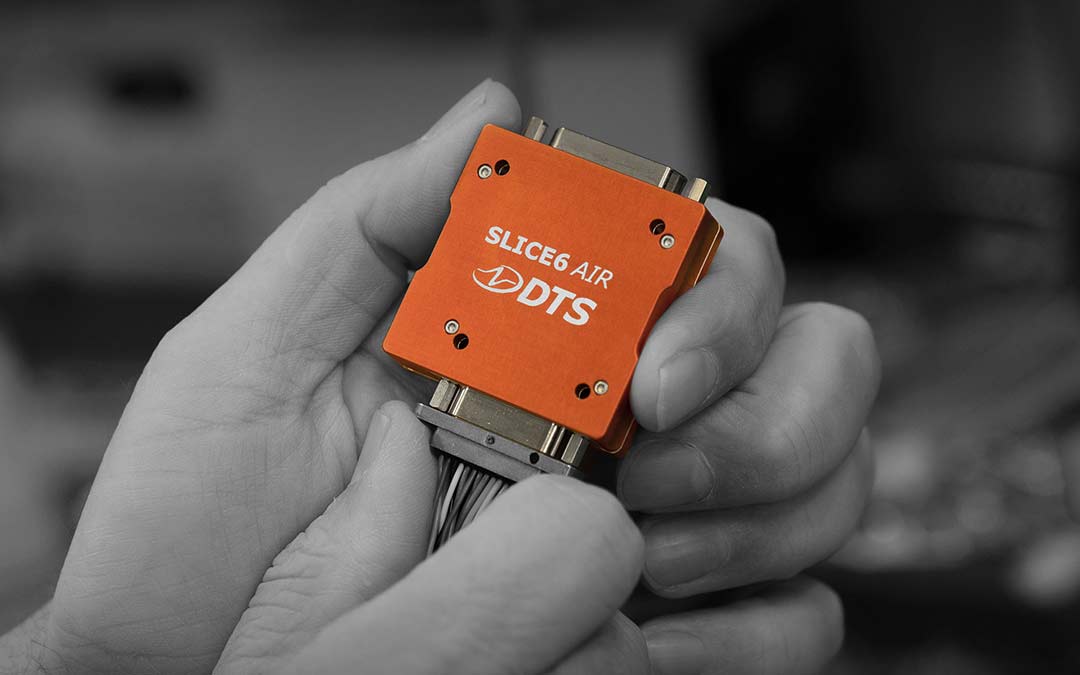
When conditions are this harsh, there is only a small window of opportunity to gather data, which is why selecting the right test instrumentation is incredibly important.  Traditional flight test instrumentation consists of a large bulky centralized data acquisition system with complicated cable running throughout the vehicle. Flight test setups are very time-and cost intensive, and this traditional solution can also lead to signal degradation due to the long sensor cables. DTS met this challenge by releasing the SLICE6 AIR, a miniature onboard data acquisition unit emerging as a market disruptor for hypersonic testing. With its rugged, SWaP-optimized packaging that could be placed near sensors, SLICE6 AIR has become the industry standard with its universal sensor support and flexible configurations.

As flight test instrumentation became more modular and lower-cost, single-function competitors began to enter the market. Engineers doing hypersonic testing have a limited need for universal sensor support for non-recoverable vehicles as they are primarily focused on measuring temperature. DTS took that industry feedback and developed an economic data acquisition system for one key sensor type: thermocouples.

The Solution: Thermocouple Data Acquisition

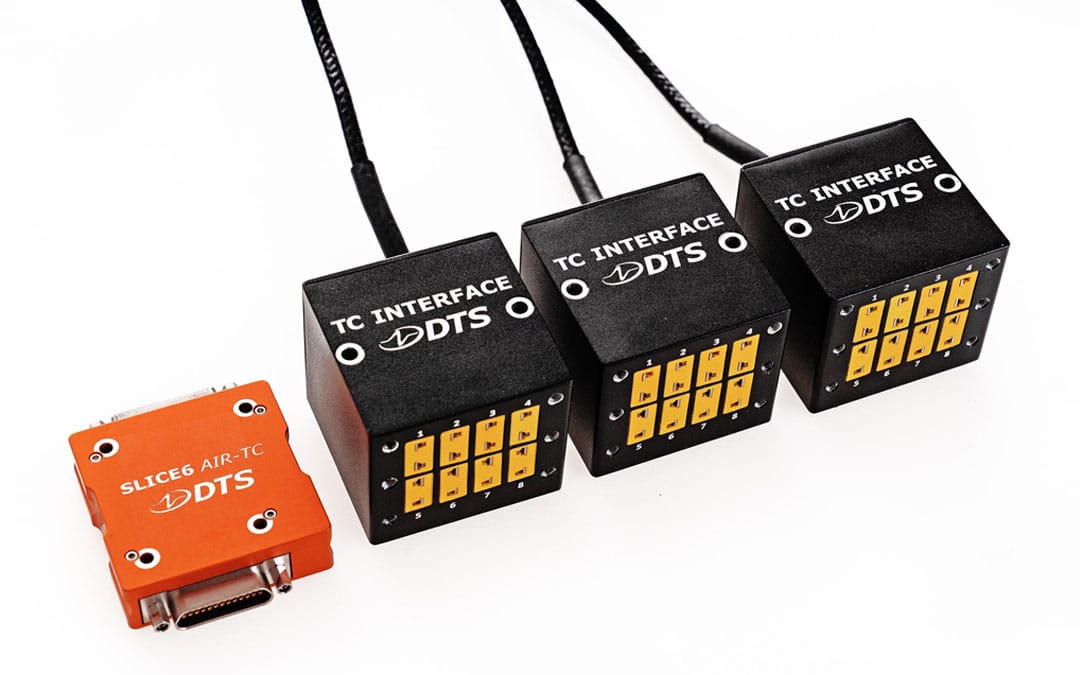
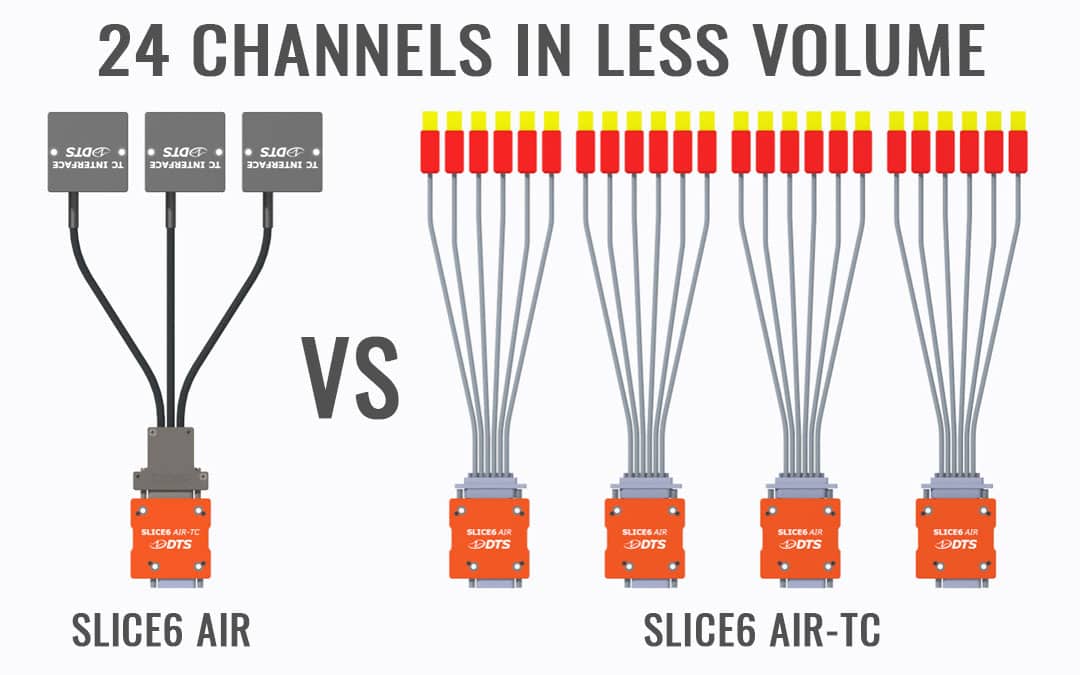
Introducing the SLICE6 AIR-TC, a thermocouple-specific data acquisition unit with less volume than its predecessor SLICE6 AIR. This SWaP-optimized system packs 24 thermocouple channels into a 42x42mm footprint, making it ideal for hypersonic flight testing. The idea was simple, make a version of the best-selling SLICE6 AIR system with key features and functionality, which meant eliminating onboard memory and universal sensor support to be cost-optimized for non-recoverable articles and test articles with tight size and mass restrictions.

The standard SLICE6 AIR-TC includes three 8-channel thermocouple interface blocks totaling 24 channels with smaller TC configurations available upon request. Each TC block handles all signal conditioning internally, incorporating cold junction compensation, a three-pole Butterworth filter, and 16-bit analog-to-digital conversion. As all conditioning is happening at the TC interface level, the module encodes and outputs that thermocouple data into an IRIG 106 compliant format (ex. Chapter 10).

Temperature Consideration in Hypersonic Environments

The TC interface is designed solely for thermocouple types K, S, T, and E. Each TC block is type-specific so multiple thermocouple types can be used simultaneously but not mixed within the same 8-channel block. This flexibility is critical in hypersonic environments where different zones of a vehicle may require different thermocouple types based on expected temperature range or material compatibility. For applications like propulsion testing, Type K thermocouples are the most common and cost-effective option, offering a temperature range of up to 1250°C. For vehicles sustaining MACH-5 speeds and 1600-2000°C temperatures, Type S is more suitable as the platinum-rhodium alloy offers greater stability in oxidizing environments. SLICE6 AIR-TC can be networked, supporting 240 thermocouple channels in one compact footprint.

SLICE6 AIR-TC for Legacy Flight Test Instrumentation

SLICE6 AIR-TC was specifically designed to be able to integrate into an existing flight test instrumentation architecture as an Ethernet-based thermocouple acquisition node without needing to completely redesign. It provides localized thermocouple signal conditioning, cold junction compensation, synchronized timing, and programmable sampling rates. It supports real-time data streaming, IRIG 106 Chapter 10, IENA, or TmNS, which allows engineers to add high-density temperature measurements while preserving the current data acquisition infrastructure and interoperability with existing FTI solutions. The unit is also shock-rated to 500g and qualified to MIL-STD-810G/461G.

The SLICE6 AIR Family

One key feature of the SLICE6 AIR-TC is that it can operate as a node of the SLICE6 AIR family platform. The SLICE6 AIR-TC shares the same communication and control bus as the SLICE6 AIR and SLICE6 AIR-BR, meaning all three modules can be daisy-chained together for a complete data acquisition system on the same test vehicle. Within this family, SLICE6 AIR-BR adds a compact strain-measurement module in the space-restrictive areas of the vehicle. A test vehicle may require mixed sensor architecture, so users do not have to choose between channel density, sensor flexibility, or time synchronicity. An engineer could easily position a SLICE6 AIR to measure shock and vibration, add a SLICE6 AIR-BR in tight spaces, and a SLICE6 AIR-TC in temperature-sensitive areas; all while maintaining synchronized timing via IRIG, GPS, or IEEE 1588 PTP.

The Future of Hypersonic Flight Testing with SLICE6 AIR-TC

The MACH-TB Program is rapidly shifting how the aerospace and defense industry approaches hypersonic flight testing. Because of the flux in industry participation, there has never been more emphasis on the need for reliable, low-cost data acquisition units for non-recoverable articles.

Since hypersonic flight testing is incredibly demanding on its equipment, a DAU can’t just survive the extreme thermodynamic conditions, it needs to deliver valid, reliable data while doing so. Whether it’s within the SLICE6 AIR platform or an existing flight test instrumentation architecture, the SLICE6 AIR-TC exceeds these expectations while supporting high-cadence testing schedules. With a short lead time of 4-6 weeks and one-third the cost-per-channel than the best-selling SLICE6 AIR, the SLICE6 AIR-TC is changing the industry by delivering low-cost, mission-critical data for hypersonic flight testing.


The SLICE6 AIR-TC allows you to position the DAU next to the sensors to reduce test set-up time and eliminate long cable runs.

While the SLICE6 AIR is our best-selling DAU, customers wanted more thermocouple support for non-recoverable and disposable test articles. Built on the same flight-tested platform as the SLICE6 AIR, SLICE6 AIR-TC supports 24 thermocouple channels with less footprint and lower cost-per-channel.

Related Articles

Physical Data: The Engine Behind Digital Twins

Physical Data: The Engine Behind Digital Twins

DTS stands at the forefront of this new digital-twins frontier. Known for miniature, rugged data acquisition systems and sensors, DTS solutions can seamlessly bridge the gap between physical systems and their digital counterparts.

DTS Webinar [Now On Demand]: Disrupting Legacy Flight Test Instrumentation

DTS Webinar [Now On Demand]: Disrupting Legacy Flight Test Instrumentation

Disrupting Legacy Flight Test Instrumentation

WEBINAR: THURSDAY, MARCH 19, 2026

Legacy flight test instrumentation is evolving fast. Miniature onboard DAQ is helping engineers capture more data, reduce wiring complexity, and install instrumentation closer to sensors. The result: better data quality, faster setups, and more efficient flight test programs.

Join this upcoming webinar with Huy Nguyen, Aerospace & Defense Sales Manager at DTS, to explore how miniaturized onboard data acquisition is changing how flight test instrumentation is deployed and is disrupting traditional flight test instrumentation. Designed for flight test engineers seeking practical alternatives, the session outlines a smarter path forward for mission-critical testing. DTS will share proven strategies for accelerating program execution, reducing integration effort, and capturing accurate, reliable data in harsh environments.

Applications for discussion: Flight testing, rotors, eVTOL, air drop, munitions, UAS and counter-UAS, launch vehicles, hypersonics, and sounding rockets.

Attendees will learn:

  1. Why SWaP optimization is essential for modern flight test instrumentation
  2. How a lower-cost, modern DAQ and telemetry approach supports emerging programs such as eVTOL, low-cost weapon systems, and counter-UAS
  3. How COTS-based DAQ architectures reduce cost and integration time while enabling faster development cycles and rapid test deployment
  4. Real-world case studies showing how DTS solutions have transformed flight testing
  5.  How customer feedback drives DTS product development and innovation.

CLICK HERE to RESERVE YOUR SPOT

NOW AVAILABLE ON DEMAND
Watch Webinar (Run time: 36 min)
Password: rhg1P20r3qxV

Physical Data: The Engine Behind Digital Twins

Physical Data: The Engine Behind Digital Twins

Physical Data: The Engine Behind Digital Twins
DTS Best Places to Work Orange County 2024

The Role of Physical Data in Building Intelligent Digital Twins

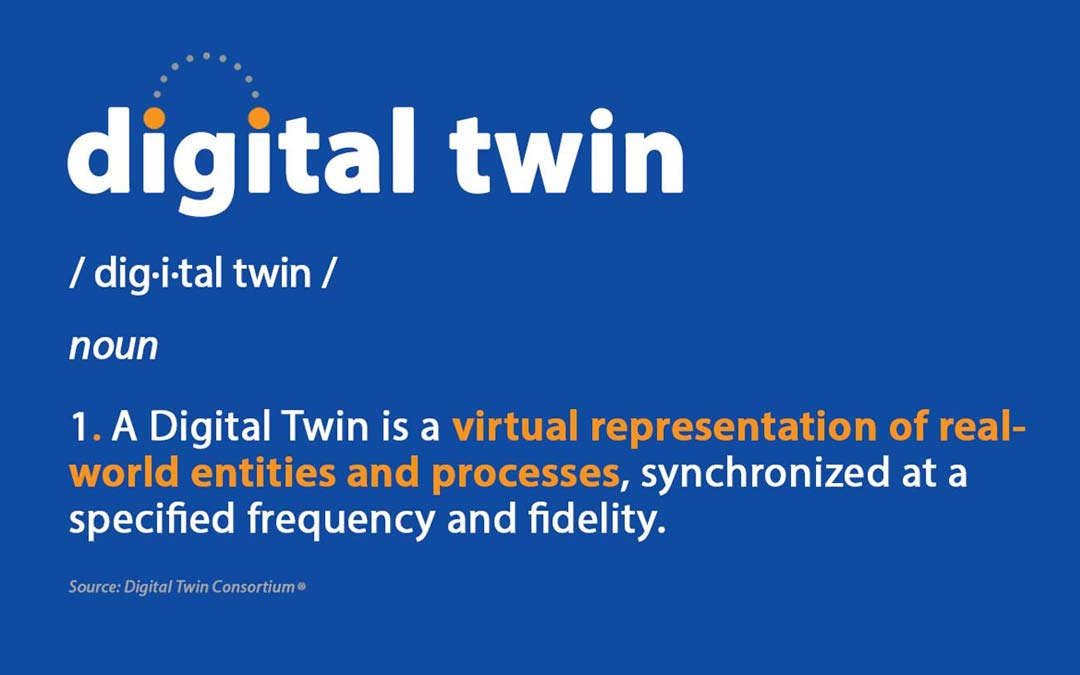
In the fast-moving world of digital twins, the accuracy and reliability of virtual models still depend on one critical factor: physical data. The success of any digital twin hinges on two essential elements – the quality of real-world data it’s built on and the ability to access that data in real-time.

DTS, a California-based leader in high-performance data recorders, is at the forefront of this digital twin revolution. Renowned for its miniature, rugged data acquisition systems (DAS) and sensors, DTS provides solutions that seamlessly bridge the gap between physical systems and their digital counterparts. From automotive and aerospace to military and industrial sectors, organizations around the world are leveraging DTS hardware to elevate their digital twin capabilities.

DTS solutions deliver high-density, precision measurements that go beyond shock, vibration, force, and temperature – enabling digital twins to be built on accurate, comprehensive datasets.

Advanced capabilities like real-time data streaming enable continuous monitoring and instant feedback for digital twin models. This is especially valuable in high-stakes environments that demand immediate analysis and decision-making — such as flight testing and military defense operations. The SLICE6 AIR onboard recorder from DTS supports real-time streaming to ensure digital twins stay synchronized with the current state of their physical counterparts.

By integrating DTS hardware into digital twin development, organizations can anchor their virtual models in precise, real-world data. This accuracy enhances the fidelity and usefulness of digital twins, allowing teams to make informed decisions, optimize system performance, and predict outcomes with confidence. As the digital twin ecosystem evolves, DTS continues to be a trusted partner, delivering the high-performance tools needed to build reliable, real-time virtual representations of physical systems.

The SLICE6 AIR onboard data acquisition unit features real-time streaming capabilities, making it ideal for supporting digital twin modeling.

Related Articles

Physical Data: The Engine Behind Digital Twins

Physical Data: The Engine Behind Digital Twins

DTS stands at the forefront of this new digital-twins frontier. Known for miniature, rugged data acquisition systems and sensors, DTS solutions can seamlessly bridge the gap between physical systems and their digital counterparts.

DTS Named Best Place to Work for 6th Year

DTS Named Best Place to Work for 6th Year

DTS Named Best Place to Work for 6th Year
DTS Best Places to Work Orange County 2024

DTS Named One of the Best Places to Work — Six Years Running!
We’re thrilled to announce that Diversified Technical Systems (DTS) has once again been named one of the Best Places to Work in Orange County for 2025! This prestigious award, presented by the Orange County Business Journal in partnership with Workforce Research Group, recognizes companies that demonstrate a strong commitment to employee satisfaction, workplace culture, and organizational excellence.

This marks the sixth consecutive year that DTS has earned this honor! It’s a testament to our unwavering commitment to creating a workplace where every team member feels valued, supported, and inspired to do their best.

“I am very proud that DTS has been recognized as one of Orange County’s Best Places to Work for the sixth year in a row. At DTS, we understand that our success is built on the well-being of our employees. We are deeply committed to fostering a culture that not only challenges and inspires but also respects the importance of life outside of work. A healthy work-life balance isn’t just a catchphrase for us; it’s a core component of our strategy for long-term success and innovation. This award validates our commitment to our team and their dedication to making DTS a truly great place to work.” — Rollin White, Head of DTS

The Best Places to Work in Orange County program involves a two-part evaluation process:

  • 20% is based on an assessment of each company’s policies, practices, and demographics
  • 80% comes directly from employee survey responses, measuring engagement, satisfaction, and overall experience

At DTS, our culture is rooted in trust, innovation, and collaboration, with a genuine appreciation for the people who make it all possible. Whether we’re engineering groundbreaking technology or celebrating major milestones, we believe the best work comes from a place where employees feel supported and valued.

A huge thank you to our incredible team for making DTS not just one of the best places to work in Orange County—but anywhere!

To learn more about the award and see the full list of 2025 honorees, visit www.BestPlacestoWorkOrangeCounty.com.

Related Articles

Physical Data: The Engine Behind Digital Twins

Physical Data: The Engine Behind Digital Twins

DTS stands at the forefront of this new digital-twins frontier. Known for miniature, rugged data acquisition systems and sensors, DTS solutions can seamlessly bridge the gap between physical systems and their digital counterparts.

Are EV’s Safer in a Crash?

Are EV’s Safer in a Crash?

Are EV’s Safer in a Crash?
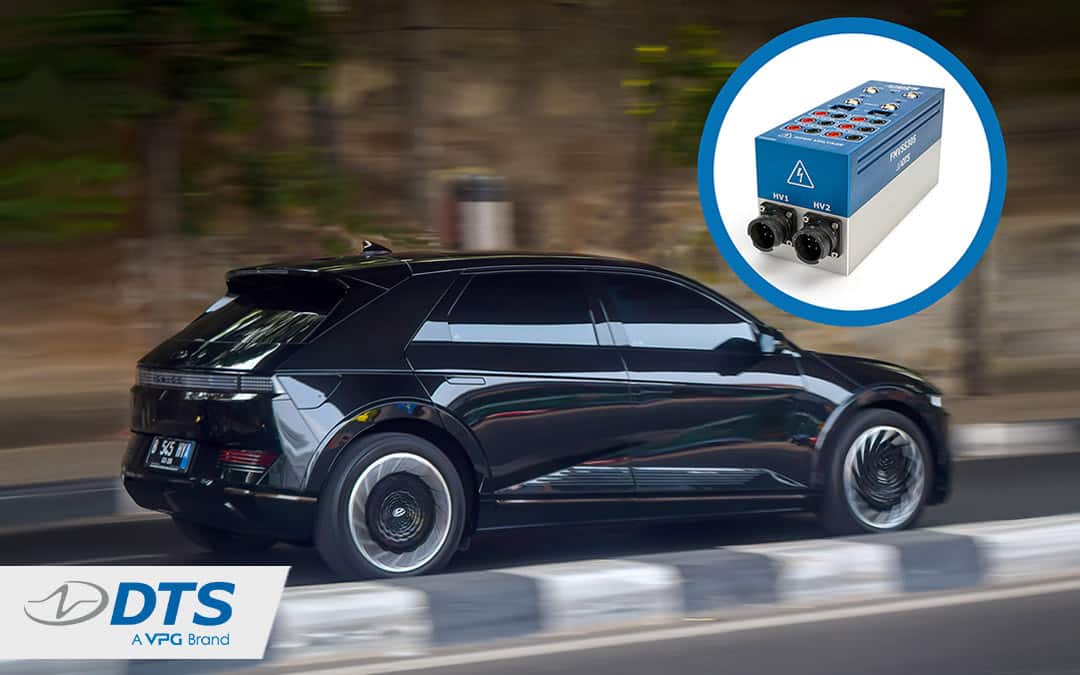
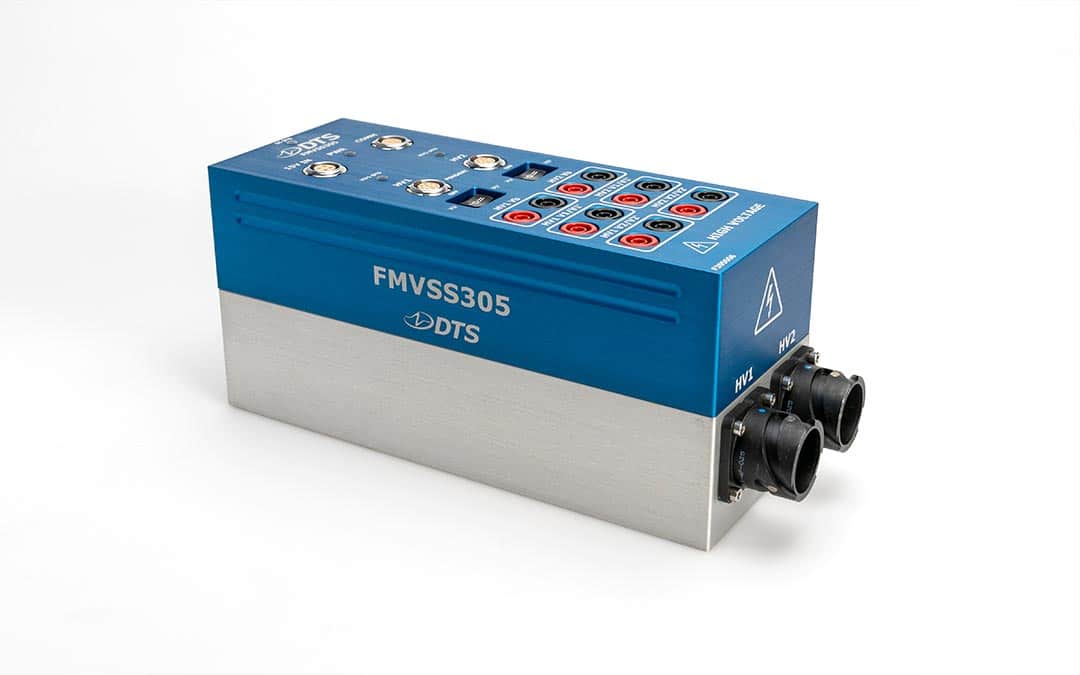
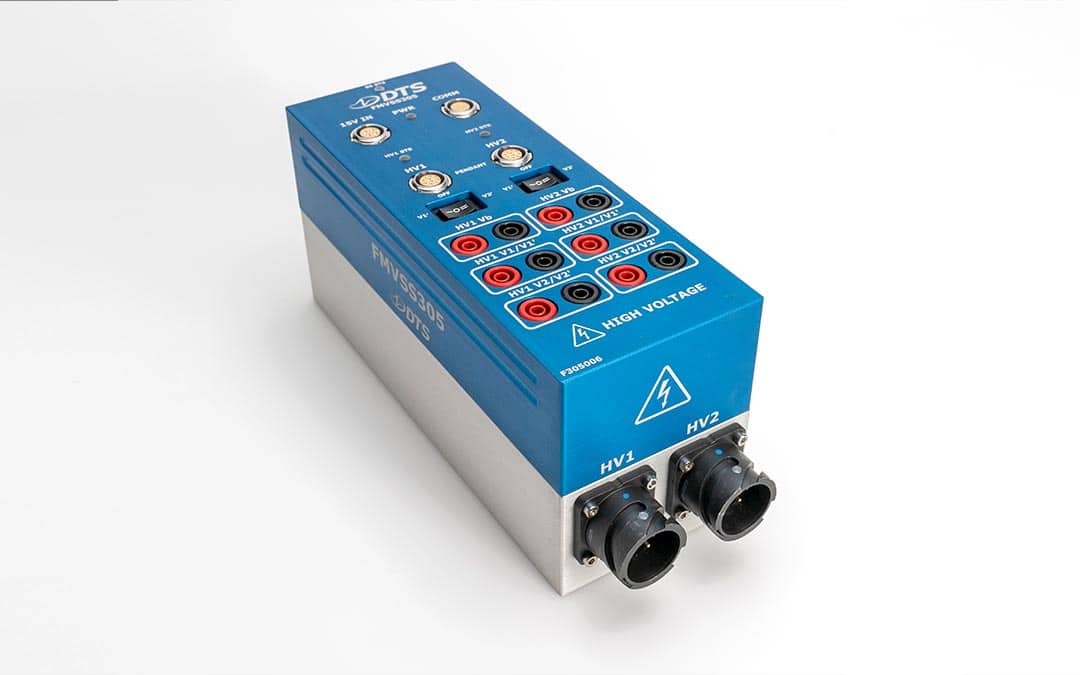
DTS FMVSS305 New High Voltage Recording Device for New Energy Vehicles - Electric Vehicle Testing

Electric vs. Gas: Which Vehicles are Safer? 

Navigating New Features, Functions, and Global Safety Requirements

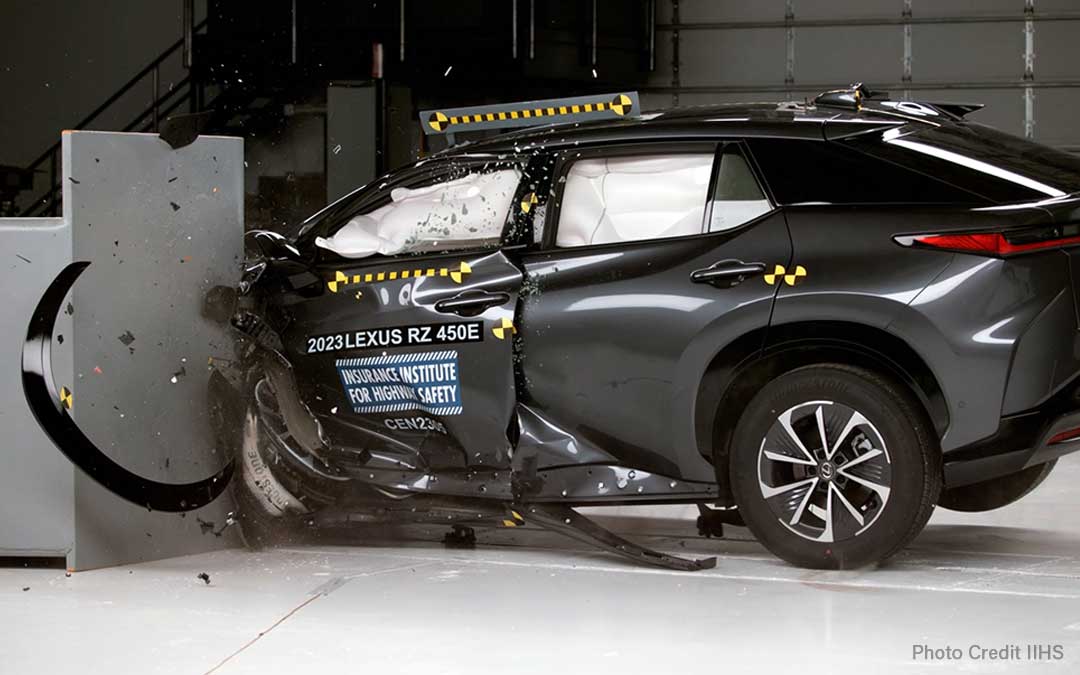
Electric and hybrid electric vehicles (EVs/HEVs) frequently outperform internal combustion engine vehicles in safety ratings, driven by design advantages such as a low center of gravity, larger crumple zones, and integrated electronic speed controls. These features enhance crash energy management and vehicle stability.

However, the shift to electrification introduces new technical challenges, particularly in crashworthiness validation and post-crash safety. High-voltage systems pose risks to occupants and emergency responders, necessitating rigorous testing under FMVSS305 and similar global standards.

Why EVs Can Be Safer: 

  • Lower center of gravity: Due to battery placement, reducing rollover risk.
  • Larger crumple zones: No engine up front allows better energy absorption in frontal crashes.
  • Advanced safety features: Many EVs come with the latest ADAS (Advanced Driver Assistance Systems).
  • Remote speed control: Some EVs allow setting and monitoring top speeds remotely — ideal for teen drivers or fleet monitoring.
  • Higher safety ratings: Several EVs (like the Tesla Model Y or Ford Mustang Mach-E) score top marks in IIHS and NHTSA crash tests.

    Potential Risks with EVs: 

    • High-voltage shock: Post-crash electrical isolation is critical to occupant and first-responder safety
    • Fire risk: While rare, battery fires can be harder to extinguish than gasoline fires.
    • Thermal runaway: Heat buildup can lead to explosions in severe impacts.
    • Heavier weight: EVs tend to be heavier, which can increase injury risk to occupants in lighter vehicles during collisions.
    • Unexpected acceleration: EVs can accelerate quickly, catching some drivers off guard, especially inexperienced drivers

      The Federal Motor Vehicle Safety Standard FMVSS305 focuses on post-crash safety for EVs. The standard mandates a minimum level of electrical isolation between the high-voltage system and the vehicle’s chassis. The goal is to isolate any electrolyte spillage from propulsion batteries to ensure occupants and first responders are protected from high-shock sources, especially following a crash.

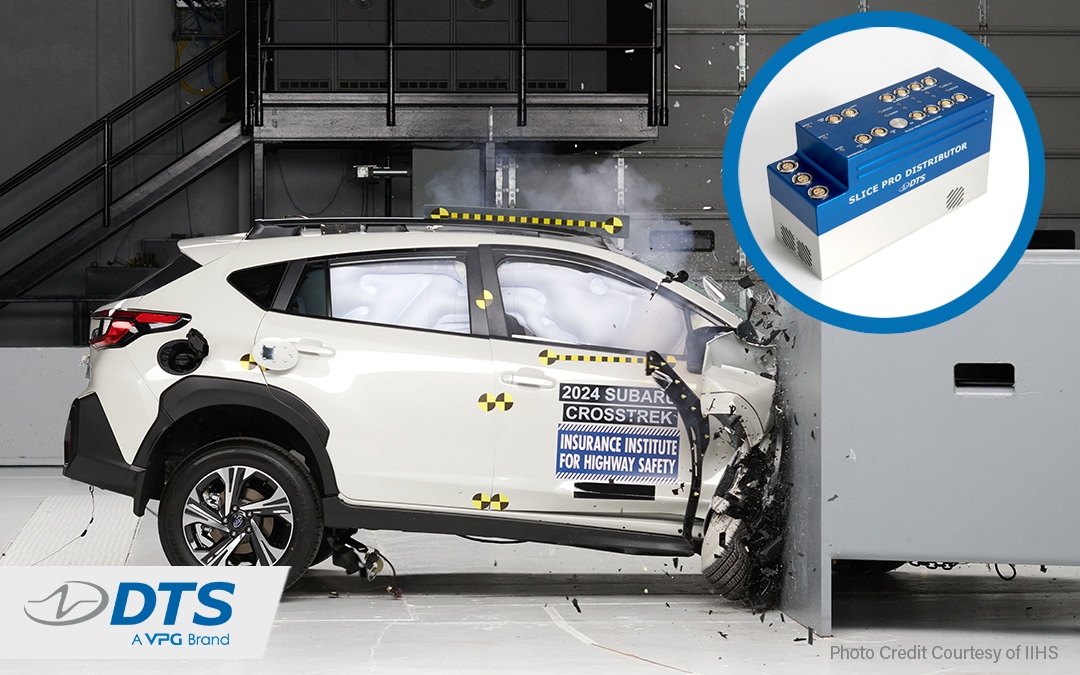
      EV Crash Test Photo Credit IIHS

      Meeting New Testing Requirements
      With new technology comes the need for new testing protocols and equipment. In response to customer requests,  DTS introduces the new FMVSS305 high-voltage recorder for testing EV and Hybrid new energy vehicles (NEVs). The DTS FMVSS305 allows for remote measurements, making it ideal for use with the 301 static rollover system.

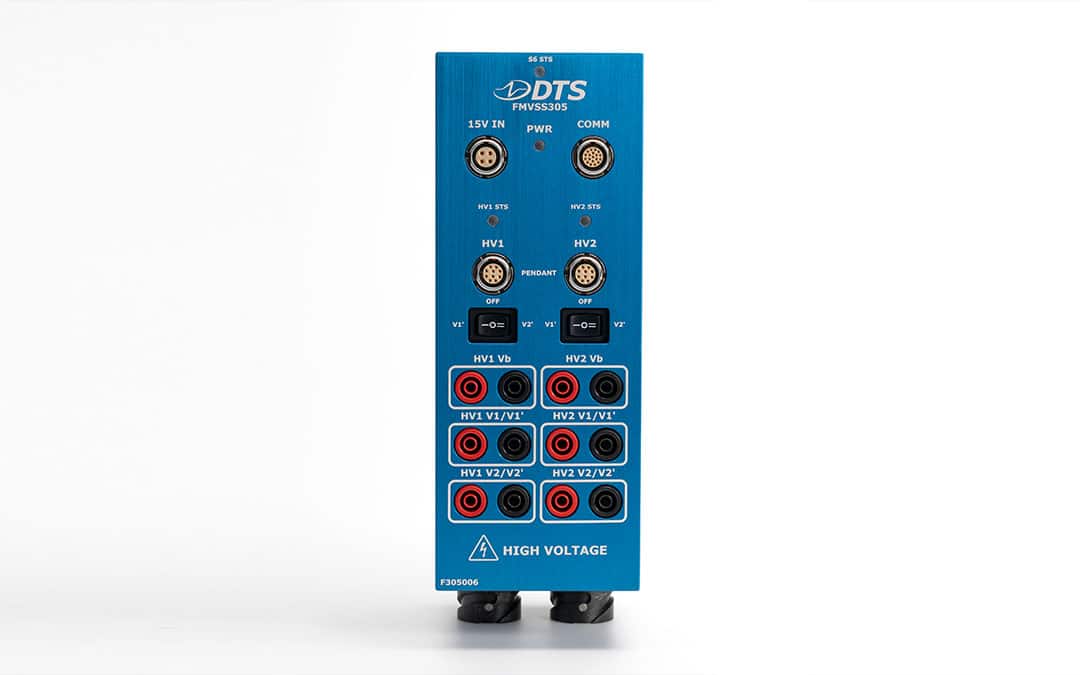
      FMVSS305 High-Voltage Recorder
      The DTS FMVSS305 is a high-voltage isolation measurement system for electric and hybrid vehicle testing. It provides a safe and reliable way to capture battery and drive system voltages up to ±1,200-volts. The unit is designed to be used standalone or can be seamlessly integrated into TDAS or SLICE data acquisition systems via DataPRO Software. For more information, click Learn More.

      The bottom line, based on all the data and safety testing, there’s no absolute winner between EVs and gas vehicles. Electric vehicles are generally as safe or safer than gas-powered vehicles, but as the fine print always says . . . it depends on the model and type of crash.

      DTS TSR AIR Data Recorder

      Related Articles

      Physical Data: The Engine Behind Digital Twins

      Physical Data: The Engine Behind Digital Twins

      DTS stands at the forefront of this new digital-twins frontier. Known for miniature, rugged data acquisition systems and sensors, DTS solutions can seamlessly bridge the gap between physical systems and their digital counterparts.

      Engineering Hall of Fame Inducts Tim Kippen

      Engineering Hall of Fame Inducts Tim Kippen

      Engineering Hall of Fame Inducts Tim Kippen
      DTS - Tim Kippen - Cal Poly Pomona Engineering Hall of Fame 2025

      DTS Co-Founder Tim Kippen Inducted into Cal Poly Pomona Engineering Hall of Fame

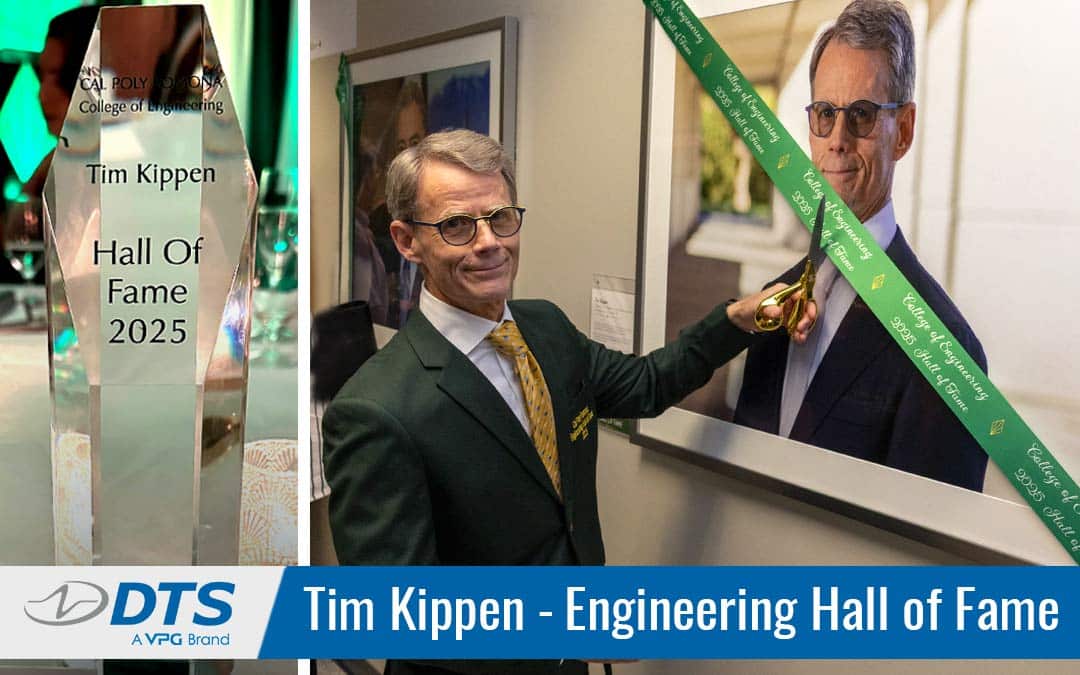
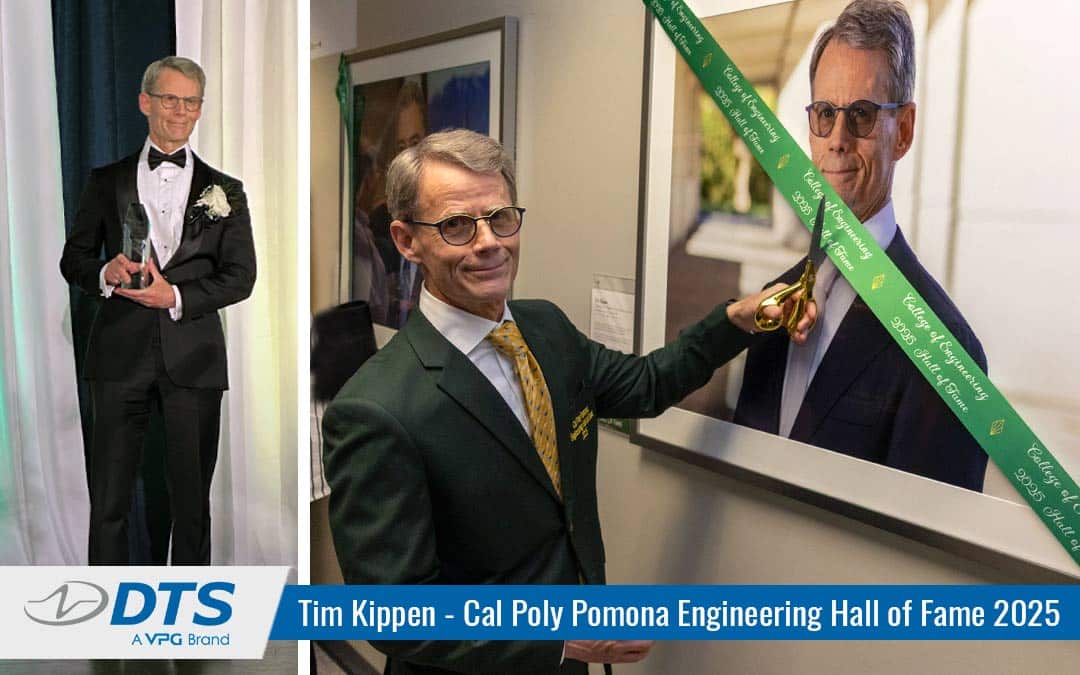
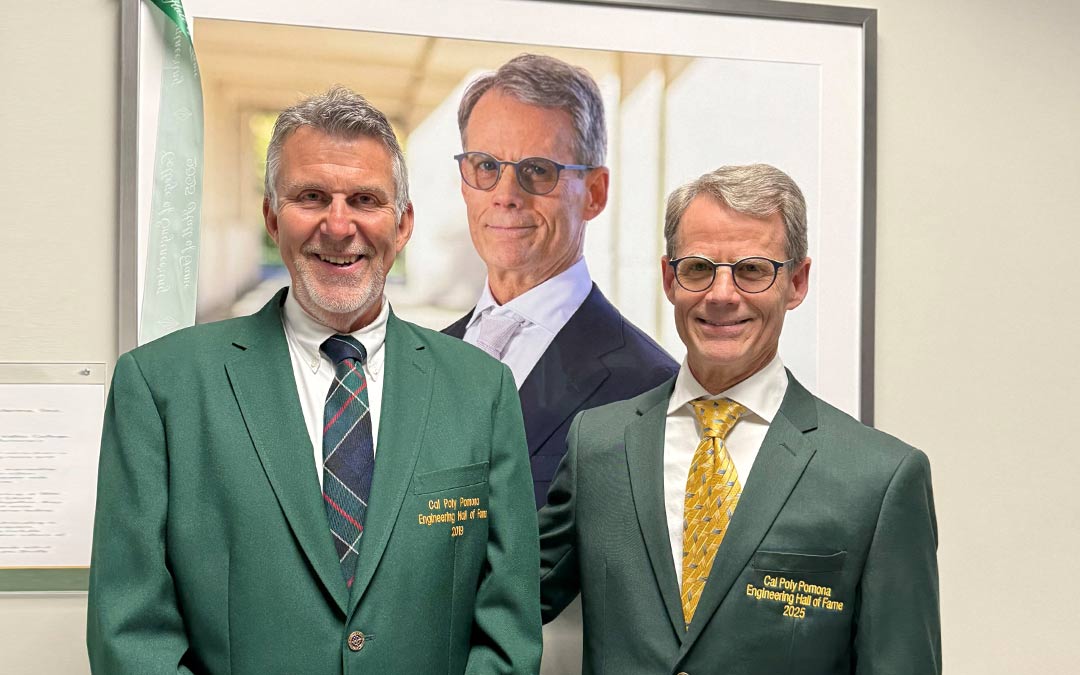
      Diversified Technical Systems (DTS) is proud to announce that co-founder Tim Kippen has been inducted into the Cal Poly Pomona College of Engineering Hall of Fame. This prestigious honor recognizes Tim’s exceptional contributions to the field of engineering and his outstanding professional achievements.

      The induction ceremony, which included family, friends and many DTS employees, was co-emceed by fellow DTS co-founder and 2019 Hall of Fame inductee Mike Beckage. The evening was filled with inspiring stories from students and inductees, highlighting the impact of Cal Poly Pomona’s engineering program.

      The connection between DTS and Cal Poly Pomona runs deep. Tim and Mike’s story began in a classroom at CPP, where they discovered a shared mindset that would shape the early culture of DTS. The university’s “learn by doing” philosophy, emphasizing hands-on learning, became a cornerstone of DTS’s collaborative environment.

      DTS’s success over the last three decades has been significantly shaped by the contributions of many Cal Poly Pomona graduates. The DTS team continues to actively support CPP engineering students through mentoring events, DTS facility tours, training events, and a generous gift of DTS hardware to inspire ongoing student R&D and engineering projects.

      Tim’s induction, alongside nine other distinguished alumni in the 2025 Hall of Fame class, celebrates his significant contributions to the engineering community and the success of DTS. His journey, rooted in the values of Cal Poly Pomona, serves as an example of how dedication and innovation can lead to remarkable achievements. Congratulations Tim on this well-deserved honor!

      DTS - Mike Beckage & Tim Kippen - Cal Poly Pomona Engineering Hall of Fame

      Mike Beckage with Tim Kippen

      DTS - Tim Kippen - Cal Poly Pomona Engineering Hall of Fame - Jacket Presentation

      Jacket Presentation

      DTS - Group photo - Tim Kippen - Cal Poly Pomona Engineering Hall of Fame Event

      DTS Group Photo

      Related Articles

      Physical Data: The Engine Behind Digital Twins

      Physical Data: The Engine Behind Digital Twins

      DTS stands at the forefront of this new digital-twins frontier. Known for miniature, rugged data acquisition systems and sensors, DTS solutions can seamlessly bridge the gap between physical systems and their digital counterparts.

      Corporate

      SLICE PRO DISTRIBUTOR – New Test Device Manages Over 800 High-Speed Data Channels

      SLICE PRO DISTRIBUTOR – New Test Device Manages Over 800 High-Speed Data Channels

      SLICE PRO DISTRIBUTOR – New Test Device Manages Over 800 High-Speed Data Channels
      DTS SLICE PRO DISTRIBUTOR New Test Device Manages Over 800 High-Speed Data Channels

      Streamlining Crash Testing: New Test Device Manages Over 800 High-Speed Data Channels

      Crash testing plays a crucial role in advancing occupant and pedestrian safety worldwide. As part of that pursuit, modern crash tests now collect vast amounts of high-speed data, a trend on the rise for decades. Originally, most of the crash data collected directly supported U.S. and Global NCAP test requirements. Today, a significant amount of additional data is being collected to advance finite element modeling or crash simulations.

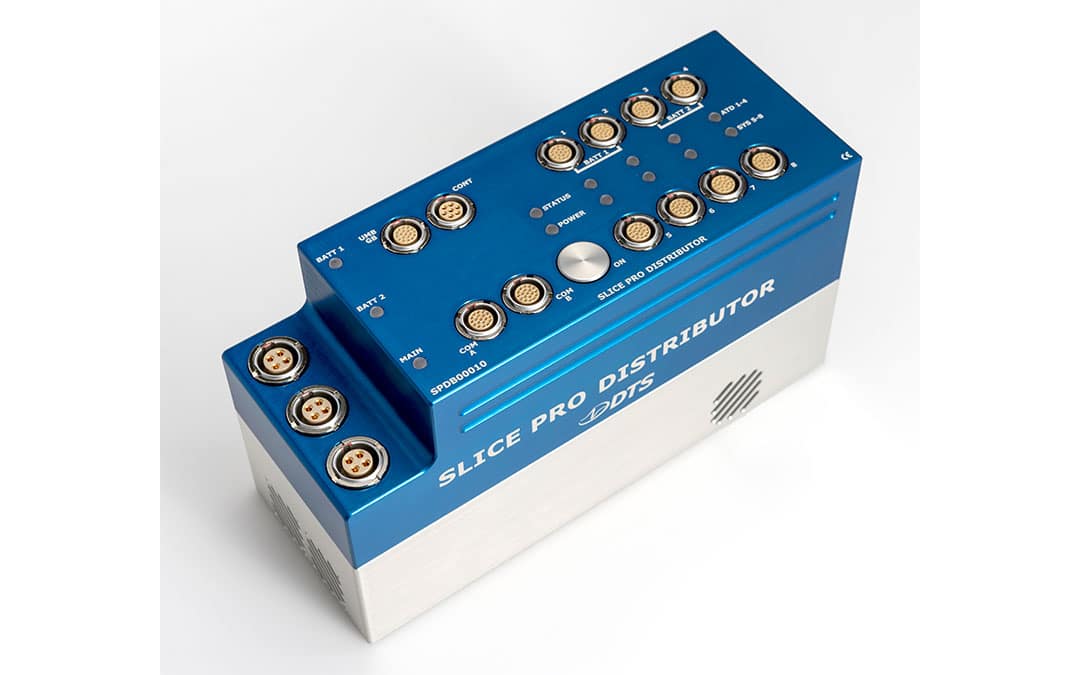
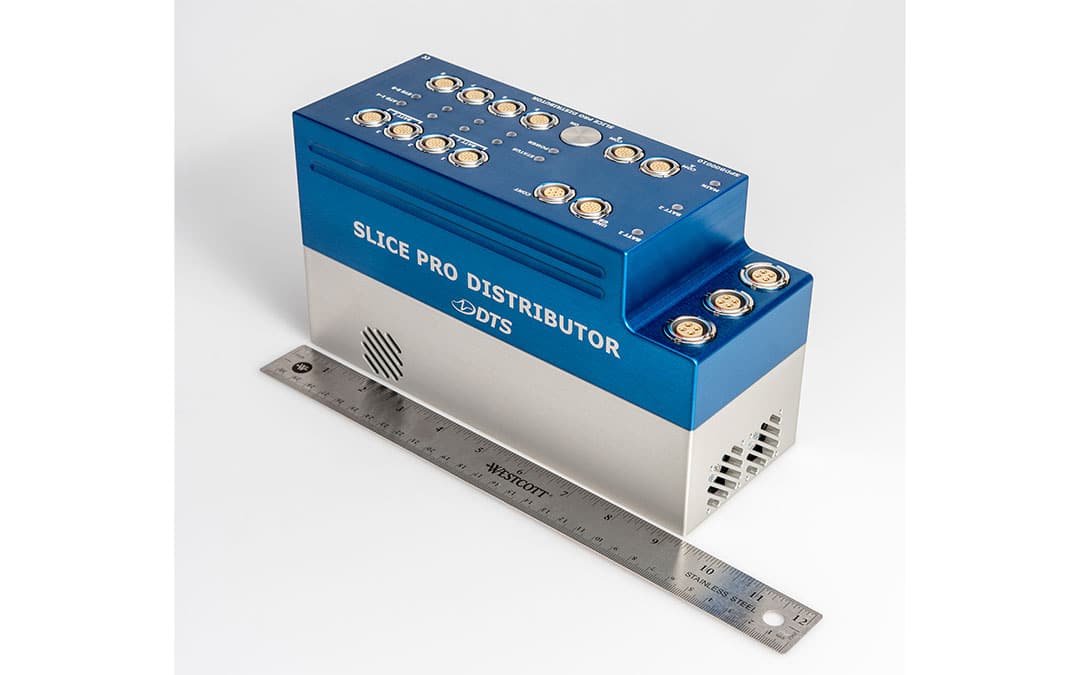
      Collecting vast amounts of data requires more complex data acquisition solutions. DTS, a leader in data acquisition systems for dynamic testing, has developed the SLICE PRO DISTRIBUTOR to simplify this complex landscape. The new test device is a centralized hub that manages signal integration, communication, and power distribution for multiple crash test dummies and up to a remarkable 820 data channels in a single vehicle.

      Managing hundreds of data channels during a crash test is a significant challenge. The SLICE PRO DISTRIBUTOR acts as a central nervous system for the test setup. Event and status signals from each connected system are isolated internally and then integrated to provide a single event and status signal for the entire system.

      “With the increasing complexity of vehicle safety testing, DTS’s goal is to simplify testing. Whether it’s 8 channels or 800, it’s all about reliability and repeatability from the test setup to the final data download,” says Chad Ivan, automotive applications manager for DTS. “The SLICE PRO DISTRIBUTOR is a game-changer for automotive testing.”

      Instead of managing multiple connections to a control PC, external switch, or wireless unit, all communication functions, diagnostics, system status monitoring, and data downloads are managed through a single connection. The SLICE PRO DISTRIBUTOR is compatible with a range of DTS products and can be easily integrated into existing test environments.

      Key features of the SLICE PRO Distributor include:
      • Compact, crashworthy enclosure
      • Gigabit Ethernet communications protocol that enables all 8 ports to simultaneously download data without throttling
      • Supports a mix of up to 820 channels of in-dummy and SLICE PRO DAS
      • Higher primary input power range of 36-56 VDC
      • The ability to support up to two POWER PRO battery units for redundant power backup

      There are ongoing discussions that debate whether physical crash testing is needed with today’s sophisticated finite element models (FEMs). As long as it’s law and physical testing is required to validate and improve modeling, crash testing will continue. The vast amount of test data collected is also advancing new vehicle designs and improving future testing. The bottom line is that more data is a global win for safety.

      DTS is a leading provider of data acquisition systems and sensors for automotive safety testing, aerospace, injury biomechanics, and other demanding applications. DTS is committed to providing innovative solutions that help its customers improve product safety and performance.

      DTS SLICE PRO DISTRIBUTOR Photo Connectors View
      DTS SLICE PRO DISTRIBUTOR Photo Connectors View

      Related Articles

      Physical Data: The Engine Behind Digital Twins

      Physical Data: The Engine Behind Digital Twins

      DTS stands at the forefront of this new digital-twins frontier. Known for miniature, rugged data acquisition systems and sensors, DTS solutions can seamlessly bridge the gap between physical systems and their digital counterparts.

      Corporate

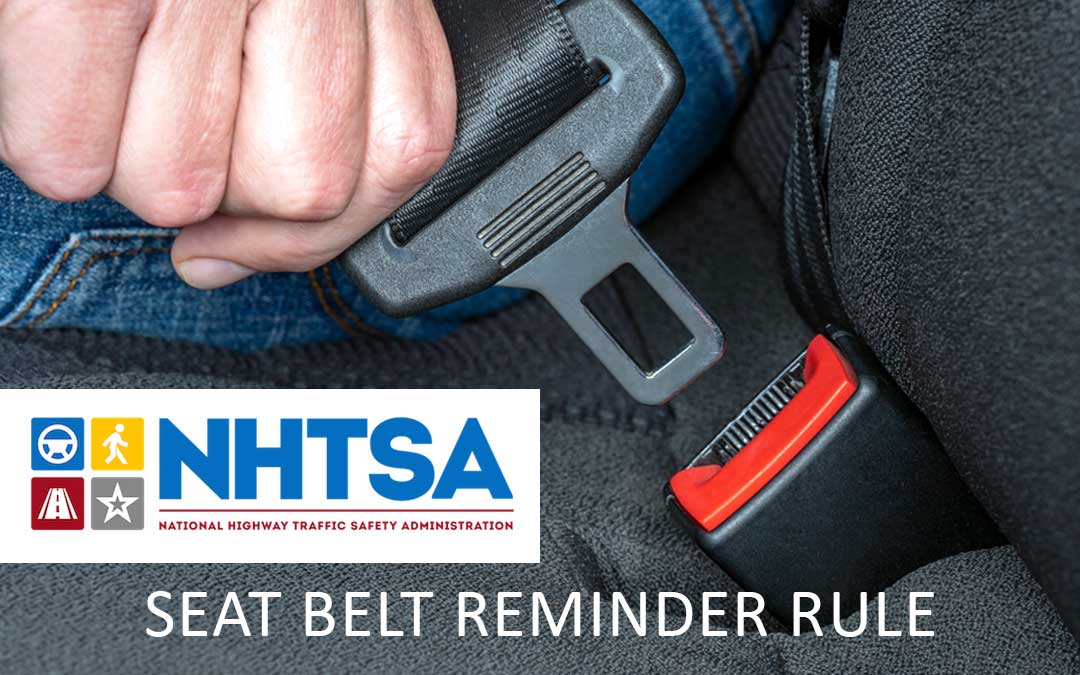
      NHTSA finalizes Seat Belt Reminder Rule to increase Seat Belt Use

      NHTSA finalizes Seat Belt Reminder Rule to increase Seat Belt Use

      NHTSA finalizes Seat Belt Reminder Rule to increase Seat Belt Use

      NHTSA finalizes Seat Belt Reminder Rule to increase Seat Belt Use

      DTS offers testing solutions designed specifically for airbag & pretensioner testing

      Final rule is estimated to save about 50 lives annually by adding a seat belt warning requirement for rear seats and enhancing warnings for driver and front passenger seats

      The U.S. Department of Transportation’s National Highway Traffic Safety Administration finalized a rule requiring seat belt use warnings for rear seats and enhanced warnings for driver and front passenger seats, a significant action aimed at increasing seat belt use and preventing injury and death in a crash. NHTSA estimates this new rule will prevent more than 500 injuries and save about 50 lives every year, once fully implemented.

      The final rule amends Federal Motor Vehicle Safety Standard No. 208, “Occupant crash protection,” which previously required a seat belt warning only for the driver’s seat. The new requirements apply to passenger cars, trucks, buses with the exception of school buses, and multipurpose passenger vehicles with a gross vehicle weight rating up to 10,000 pounds.

      Manufacturers must meet the enhanced front seat belt warning system requirements on new vehicles starting Sept. 1, 2026. The rear seat belt warning system will be required on new vehicles as of Sept. 1, 2027. Manufacturers are welcome to comply with the rule before these deadlines.

      “Wearing a seat belt is one of the easiest and most effective ways to prevent injury and death in a vehicle crash,” NHTSA Chief Counsel Adam Raviv said. “While seat belt use has improved for decades, there’s still more we can do to make sure everyone buckles up. These new requirements will help to increase seat belt use, especially for rear seat passengers, by enhancing reminders for vehicle occupants to buckle up.”

      Seat belt warning systems, also called reminder systems, use visual and audible alerts to encourage seat belt use. Usage rates for rear seat passengers have consistently been below those for the front seats, with front seat belt use at about 91.6% and rear seat belt use at about 81.7% in 2022. Approximately half of all passenger vehicle occupants who died in crashes in 2022 were unbelted, according to data from NHTSA’s Fatality Analysis Reporting System.

      NHTSA has finalized a significant number of safety initiatives aimed at reducing traffic deaths, such as a new requirement for passenger cars and light trucks to come equipped with automatic emergency braking systems, including pedestrian AEB, by 2029. The agency also finalized significant updates to its 5-Star Safety Ratings program, known as the New Car Assessment Program, that include new advanced driver assistance technologies, a crashworthiness pedestrian protection program, and a roadmap for future program changes over the next 10 years. These initiatives support the Department’s National Roadway Safety Strategy, launched in January 2022, which provides a roadmap to achieving the only acceptable number of deaths on our roads: zero.

      More Information: nhtsa.gov/press

      Author/Source: NHTSA

      The text, images, graphics, sound files, animation files, video files and their arrangement on the news sites are all subject to Copyright and other intellectual property protection. The author resp. the authors can be find on the more information link.

      Related Articles

      Physical Data: The Engine Behind Digital Twins

      Physical Data: The Engine Behind Digital Twins

      DTS stands at the forefront of this new digital-twins frontier. Known for miniature, rugged data acquisition systems and sensors, DTS solutions can seamlessly bridge the gap between physical systems and their digital counterparts.

      NASA Spinoff – Better Data for Bodies in Motion

      NASA Spinoff – Better Data for Bodies in Motion

      NASA Spinoff – Better Data for Bodies in Motion

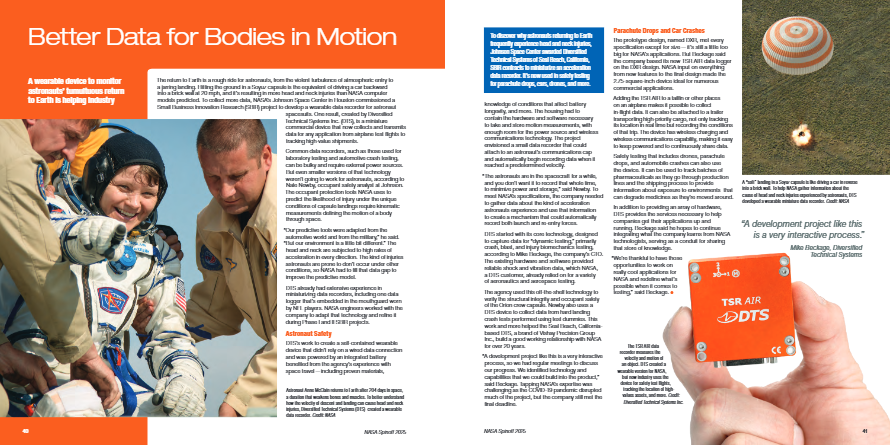
      Better Data for Bodies in Motion

      A wearable device to monitor astronauts’ tumultuous return to Earth is helping industry

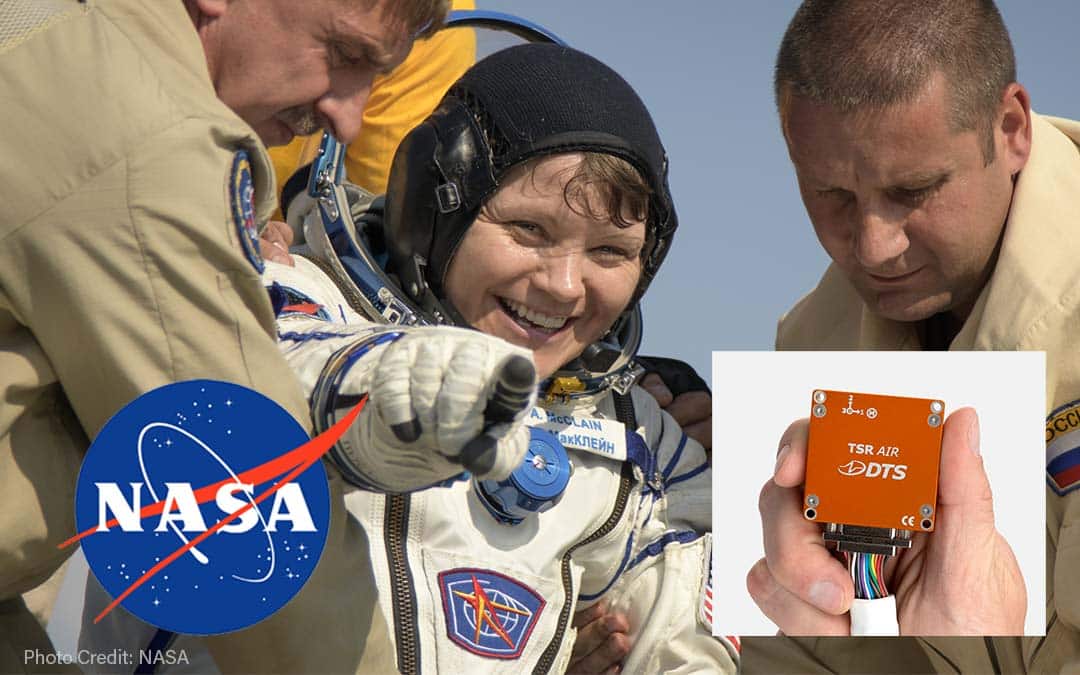
      The DTS Story: In 2019, NASA’s Johnson Space Center in Houston selected DTS for a Small Business Innovation Research (SBIR) project to develop a wearable data recorder for astronaut spacesuits. DTS developed the Dynamic Kinematic Recorder (DKR) for NASA. That technology was then spun off to create the TSR AIR data logger, which is now used for a variety of applications including flight testing and tracking high-value shipments like satellites.

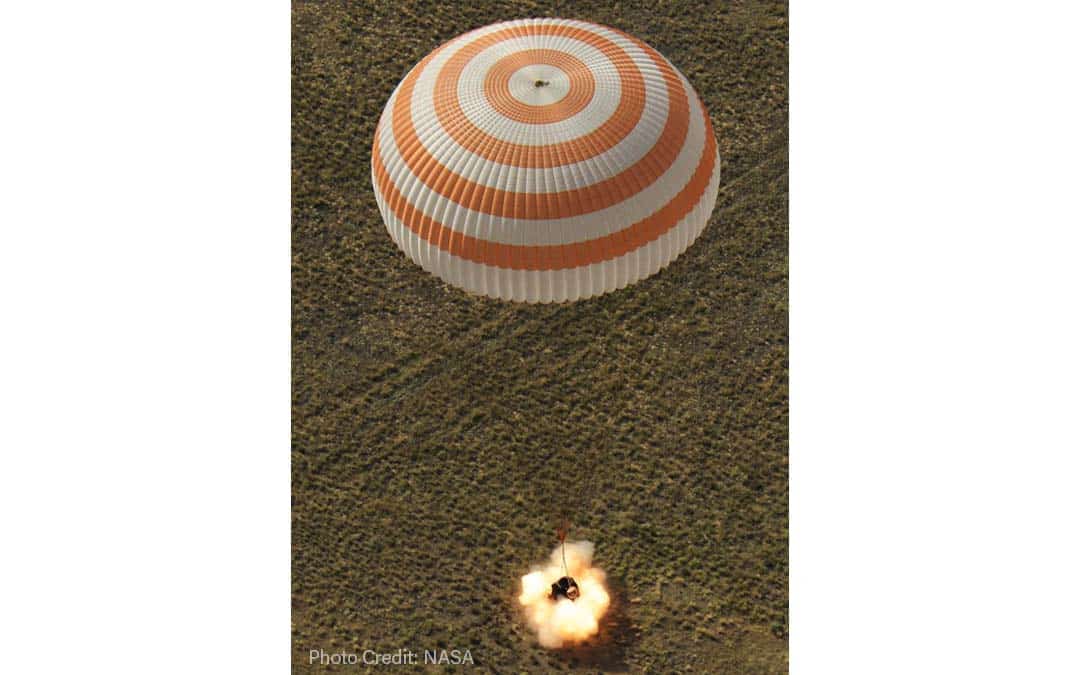
      The return to Earth is a rough ride for astronauts, from the violent turbulence of atmospheric entry to a jarring landing. Hitting the ground in a Soyuz capsule is the equivalent of driving a car backward into a brick wall at 20 mph, and it’s resulting in more head and neck injuries than NASA computer models predicted. To collect more data, NASA’s Johnson Space Center in Houston commissioned a Small Business Innovation Research (SBIR) project to develop a wearable data recorder for astronaut spacesuits. One result, created by Diversified Technical Systems Inc. (DTS), is a miniature commercial device that now collects and transmits data for any application from airplane test flights to tracking high-value shipments.

      Common data recorders, such as those used for laboratory testing and automotive crash testing, can be bulky and require external power sources. But even smaller versions of that technology weren’t going to work for astronauts, according to Nate Newby, occupant safety analyst at Johnson. The occupant protection tools NASA uses to predict the likelihood of injury under the unique conditions of capsule landings require kinematic measurements defining the motion of a body through space.

      “Our predictive tools were adapted from the automotive world and from the military,” he said. “But our environment is a little bit different.” The head and neck are subjected to high rates of acceleration in every direction. The kind of injuries astronauts are prone to don’t occur under other conditions, so NASA had to fill that data gap to improve the predictive model.

      DTS already had extensive experience in miniaturizing data recorders, including one data logger that’s embedded in the mouthguard worn by NFL players. NASA engineers worked with the company to adapt that technology and refine it during Phase I and II SBIR projects.

      Astronaut Safety

      DTS’s work to create a self-contained wearable device that didn’t rely on a wired data connection and was powered by an integrated battery benefited from the agency’s experience with space travel — including proven materials, knowledge of conditions that affect battery longevity, and more. The housing had to contain the hardware and software necessary to take and store motion measurements, with enough room for the power source and wireless communications technology. The project envisioned a small data recorder that could attach to an astronaut’s communications cap and automatically begin recording data when it reached a predetermined velocity.

      “The astronauts are in the spacecraft for a while, and you don’t want it to record that whole time, to minimize power and storage,” said Newby. To meet NASA’s specifications, the company needed to gather data about the kind of acceleration astronauts experience and use that information to create a mechanism that could automatically record both launch and re-entry forces.

      DTS started with its core technology, designed to capture data for “dynamic testing,” primarily crash, blast, and injury biomechanics testing, according to Mike Beckage, the company’s CTO. The existing hardware and software provided reliable shock and vibration data, which NASA, a DTS customer, already relied on for a variety of aeronautics and aerospace testing.

      The agency used this off-the-shelf technology to verify the structural integrity and occupant safety of the Orion crew capsule. Newby also uses a DTS device to collect data from hard landing crash tests performed using test dummies. This work and more helped the Seal Beach, California-based DTS, a brand of Vishay Precision Group Inc., build a good working relationship with NASA for over 20 years.

      “A development project like this is a very interactive process, so we had regular meetings to discuss our progress. We identified technology and capabilities that we could build into the product,” said Beckage. Tapping NASA’s expertise was challenging as the COVID-19 pandemic disrupted much of the project, but the company still met the final deadline.

      Parachute Drops and Car Crashes

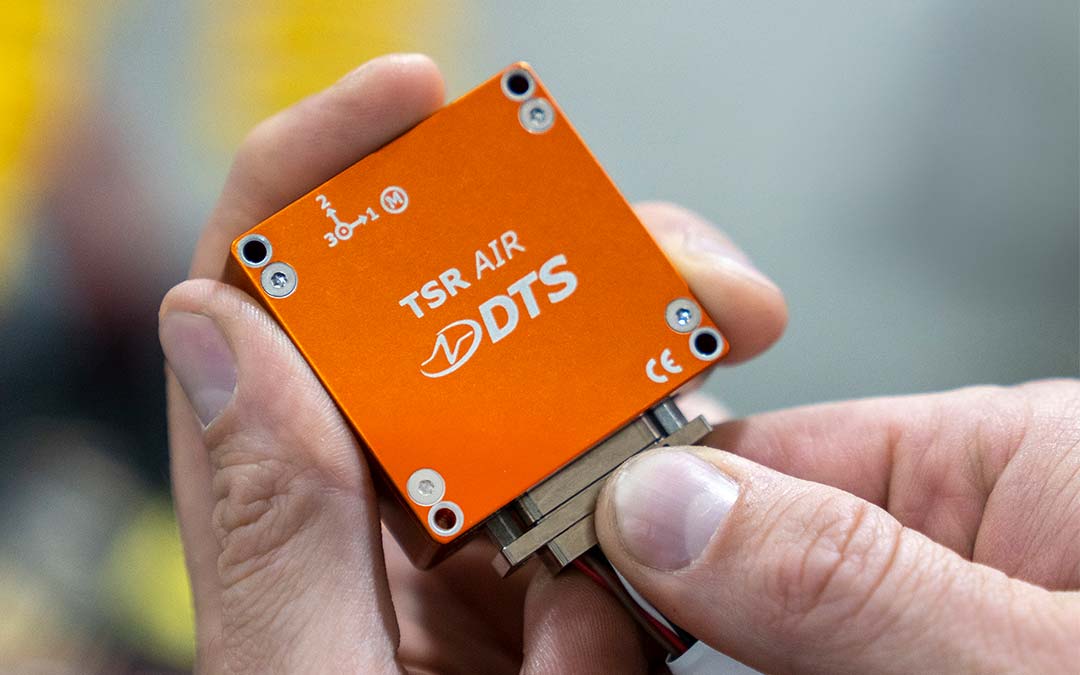
      The prototype design, named DXR, met every specification except for size — it’s still a little too big for NASA’s applications. But Beckage said the company based its new TSR AIR data logger on the DXR design. NASA input on everything from new features to the final design made the 2.75-square-inch device ideal for numerous commercial applications.

      Adding the TSR AIR to a tailfin or other places on an airplane makes it possible to collect in-flight data. It can also be attached to a trailer transporting high-priority cargo, not only tracking its location in real time but recording the conditions of that trip. The device has wireless charging and wireless communications capability, making it easy to keep powered and to continuously share data.

      Safety testing that includes drones, parachute drops, and automobile crashes can also use the device. It can be used to track batches of pharmaceuticals as they go through production lines and the shipping process to provide information about exposure to environments that can degrade medicines as they’re moved around.

      In addition to providing an array of hardware, DTS provides the services necessary to help companies get their applications up and running. Beckage said he hopes to continue integrating what the company learns from NASA technologists, serving as a conduit for sharing that store of knowledge.

      “We’re thankful to have those opportunities to work on really cool applications for NASA and redefine what’s possible when it comes to testing,” said Beckage.

      Astronaut Anne McClain returns to Earth after 204 days in space, a duration that weakens bones and muscles. To better understand how the velocity of descent and landing can cause head and neck injuries, Diversified Technical Systems (DTS) created a wearable data recorder. Credit: NASA

      A “soft” landing in a Soyuz capsule is like driving a car in reverse into a brick wall. To help NASA gather information about the cause of head and neck injuries experienced by astronauts, DTS developed a wearable miniature data recorder. Credit: NASA

      DTS TSR AIR Data Recorder

      The TSR AIR data recorder measures the velocity and motion of an object. DTS created a wearable version for NASA, but now industry uses the device for safety test flights, tracking the location of high-values assets, and more.

      Related Articles

      Physical Data: The Engine Behind Digital Twins

      Physical Data: The Engine Behind Digital Twins

      DTS stands at the forefront of this new digital-twins frontier. Known for miniature, rugged data acquisition systems and sensors, DTS solutions can seamlessly bridge the gap between physical systems and their digital counterparts.

      HELP CENTER